

At a glance
1. NusaVest and digital lenders
2. Institutional non-bank investors
3. US and European investors
1. Targets US$2 billion securities trades
2. Built originate-to-distribute platform
3. Connects lenders with investors
1. Built over 12–18 months
2. Targets three-year milestone
3. Digital economy doubles by 2030
1. Southeast Asia digital economy
2. Multiple ASEAN markets targeted
3. Capital sourced from US, Europe
1. ASEAN digital economy expanding rapidly
2. Banks face funding capacity limits
3. Need additional investment channels
1. Aggregate small-ticket ASEAN loans
2. Package loans into securities
3. Sell bonds to investors
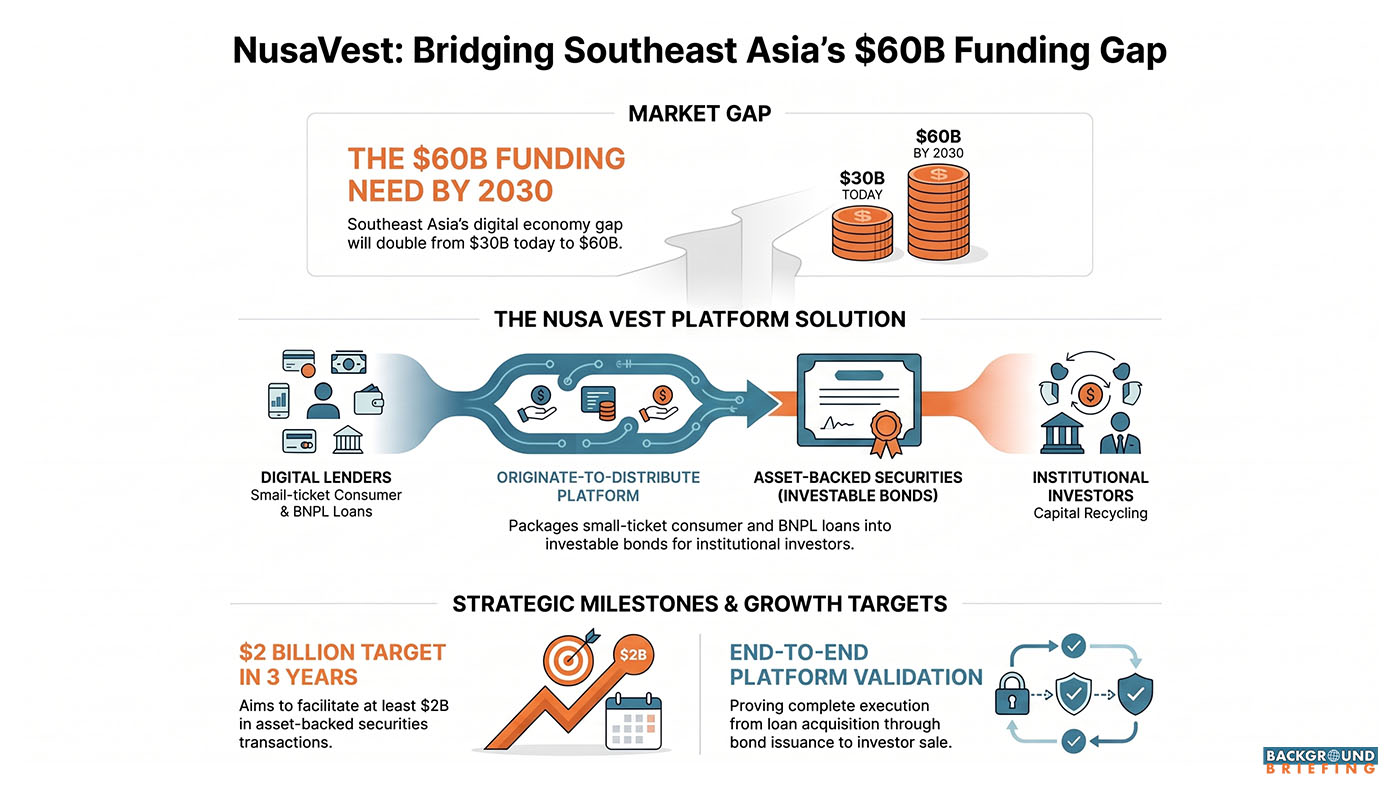
NusaVest is aiming to facilitate at least US$2 billion in asset-backed securities transactions over the next three years as it seeks to address a growing funding gap in Southeast Asia’s digital economy, which it estimates will expand from US$30 billion today to US$60 billion by 2030.
The company has spent the past 12 to 18 months building an end-to-end originate-to-distribute platform designed to enable loan originators to transfer loan assets through a true-sale mechanism. The platform packages pools of consumer and digital-economy loans into investable securities, providing additional funding capacity beyond traditional banking channels.
“We founded NusaVest because we see a big problem in the digital economy in Southeast Asia. At the moment, the size of the digital economy is thirty billion US dollars and it is predicted to grow to sixty billion dollars in 2030. The banks currently funding the economy will not have enough capacity to help it grow,” Marnix Zwart, CEO and Co-Founder of NusaVest told BackgroundBriefing.news.
The company’s originate-to-distribute platform was developed around three requirements: supporting millions of small-ticket loans, ensuring regulatory compatibility for securitisation structures, and creating sufficiently large pools of assets to attract institutional non-bank investors.
Why does Southeast Asia need an originate-to-distribute platform?
According to Zwart, many fintech and digital lending platforms already provide buy now, pay later loans, cash loans and short-term financing products. However, a mechanism for transferring those assets to institutional investors remains largely absent in the region.
“There are many platforms that originate customers and give them buy now, pay later loans, cash loans and shorter loans. What has been missing is a company like NusaVest, an asset manager in the middle that helps them take these loans off their balance sheet and sell them to institutional investors.”
By moving assets through its originate-to-distribute platform, lenders are able to recycle capital and continue originating new loans. NusaVest aggregates selected loans, places them onto its platform, and packages them into bonds or notes for institutional investors.
The model is intended to connect digital lenders and e-commerce financing providers with global capital markets while giving overseas investors access to Southeast Asian credit assets.
What milestones is NusaVest targeting?
The company’s first objective is to prove that its originate-to-distribute platform can operate successfully from loan acquisition through to bond issuance and investor participation.
“We need proof that it works end-to-end, showing that we can actually issue these bonds and that institutional investors will buy them from us.”
A second target is to facilitate at least US$2 billion in asset-backed securities transactions within three years. NusaVest also plans to expand its originate-to-distribute platform across multiple Southeast Asian markets as demand for financing grows alongside the region’s digital economy.
The company believes this approach could help bridge part of the funding gap created by rapid digital-economy expansion while providing institutional investors with a new channel for accessing Southeast Asian consumer-credit assets.
More stories: Standard Chartered targets AI scale across 50+ markets to smoothen banking friction
Transcript of the interview:
We founded NusaVest because we see a big problem in the digital economy in Southeast Asia. At the moment, the size of the digital economy is thirty billion US dollars to be precise, and it is predicted to grow to sixty billion dollars in 2030.
In four years, the digital economy is doubling in size, and the banks currently funding the economy will not have enough capacity to help it grow. That is the reason why we started NusaVest to see if we can help bridge these funding issues.
There are three important components to what we have done. So let me explain what we have built over the last twelve to eighteen months.
- First, on the platform side, these are millions of small ticket size loans, so you need a platform that is able to book, replenish, and continue booking these loans.
- Second, we had to enhance the processes to make sure that they are regulatory compatible and allowed, as packaging and securitizing loans is normal in the US and Europe but new to Southeast Asia.
- Third, you need to bundle a lot of these loans together to make them sizable enough and interesting enough for institutional non-bank investors to buy.
To summarize what we have done, we built an end-to-end originate-to-distribute platform that now gives US or European investors access to Southeast Asian markets. That is what we have been building over the last twelve to eighteen months.
Presumably, there are quite a number of these companies around that do things like buy now, pay later. What unique thing do you bring to this puzzle piece?
There are many platforms that originate customers and give them buy now, pay later loans, cash loans, and shorter loans to help them acquire products online in the digital economy. What has been missing is a company like NusaVest, an asset servicer in the middle that helps them take these loans off their balance sheet and sell them to institutional investors.
By taking these loans off their balance sheet, they can redeploy their capital again. That is really where NusaVest comes in as the connector between platforms like Grab, Shopee, or Atomi and institutional non-bank investors.
We take part of their loans, put them on our platform, and bundle them together into a bond or a note which we then sell to these institutional investors. That has not been done at the moment in Southeast Asia, so this will be a market first.
Ultimately, what are the goals you are shooting for here?
I think we have three KPIs that really matter to us. Let me outline where we are aiming as NusaVest.
- First, we need proof that it works end-to-end, showing that we can actually issue these bonds and that institutional investors will buy them from us.
- Second, we want to bridge the gap between thirty and sixty billion dollars, believing we can do at least two billion dollars of asset-backed securities trades in the next three years.
- Third, we aim to achieve this across multiple markets in Southeast Asia.