


At a glance
1. Standard Chartered bank
2. Guy Sheppard, AI strategy head
3. Clients across 50+ markets
1. Scaling AI across 50+ markets
2. Reducing cross-border banking friction
3. Standardising AI deployment processes
1. Current AI rollout phase
2. Next 12-18 months
3. Long-term scaling roadmap
1. Singapore-based global operations
2. Across 50+ international markets
3. Asia, ASEAN and global corridors
1. Improve client banking experience
2. Support cross-border banking growth
3. Create scalable operational efficiencies
1. Simplifying client onboarding processes
2. Deploying scalable AI frameworks
3. Standardising implementation across markets
Standard Chartered is prioritising client-focused artificial intelligence initiatives that can be scaled across its 50+ markets, with the bank focusing on reducing friction in cross-border banking, accelerating deployment and standardising implementation across its global network.
Guy Sheppard, Executive Director and Head of AI Strategy and Adoption, Group AI Enablement, said the bank’s AI strategy is centred on three objectives: maintaining a focus on measurable value, scaling successful deployments, and simplifying how AI is developed and rolled out across the organisation.
Rather than treating AI as a technology experiment, the bank is targeting practical improvements for clients navigating complex international banking services.
“Standard Chartered is not doing AI because it is cool. We are hyperfocused on how we can help our clients touch and feel the impacts of the experiments, the use cases, and the innovations that we have driven in AI,” Guy Sheppard, Executive Director, Head of AI Strategy and Adoption, told BackgroundBriefing.news.
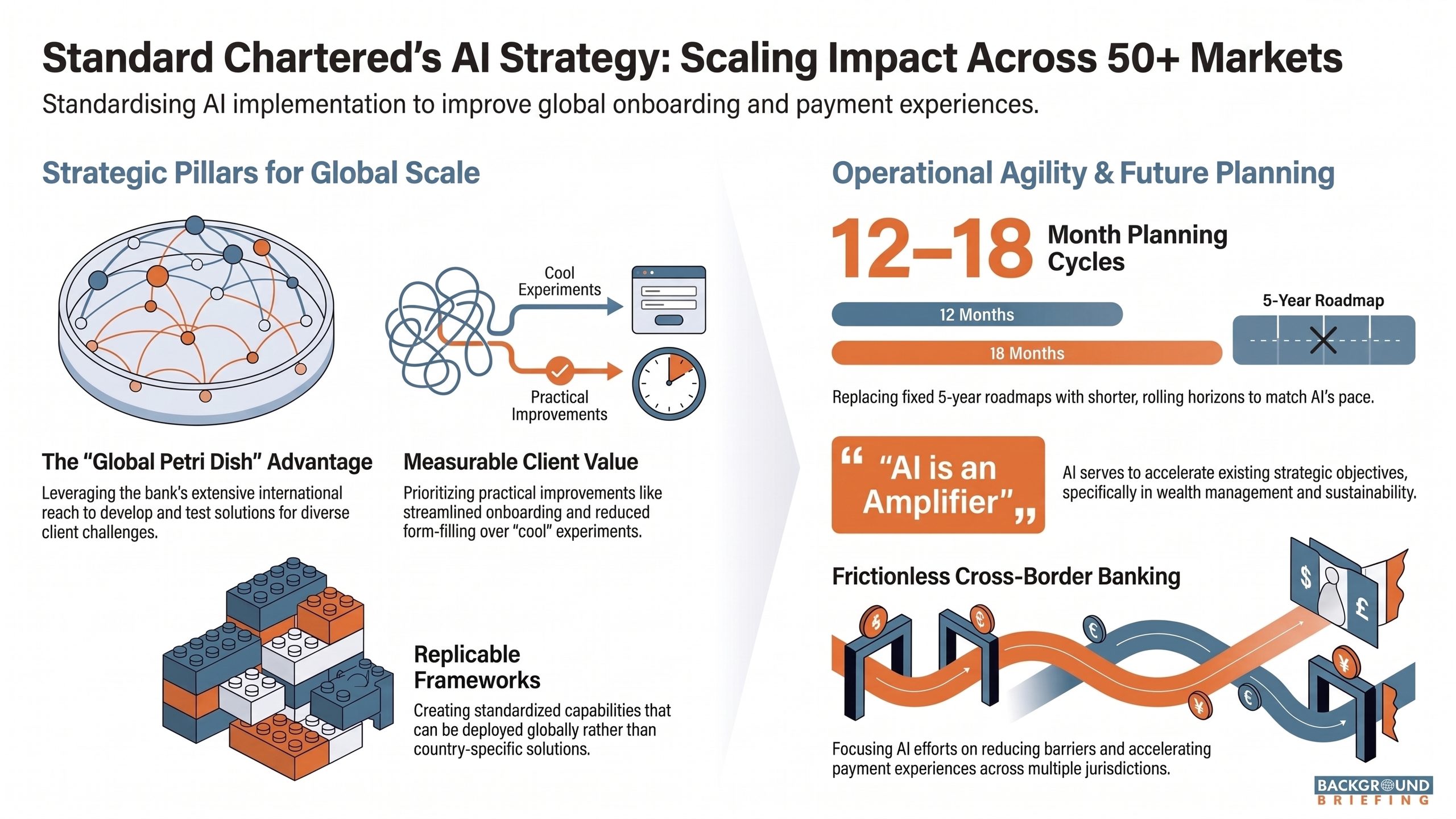
According to Sheppard, the bank sees opportunities to use AI strategy and adoption initiatives to streamline onboarding processes, reduce form-filling requirements and improve payment experiences across multiple jurisdictions and currencies.
The approach reflects the operational complexity of a bank operating in 50+ markets, where regulatory requirements and client expectations vary significantly. Rather than creating market-specific solutions, the institution aims to develop capabilities that can be replicated globally.
Why does Standard Chartered believe its scale creates an AI advantage?
Sheppard argued that the bank’s international footprint provides a broader range of client challenges on which to develop and test solutions.
He described Standard Chartered’s geographic reach as providing “the world’s largest petri dish” of client problems, adding that successful projects must be designed for large-scale deployment from the outset.
“Everything has to have the ability to scale massively. This will drive real value for our client, our employees and our shareholders.”
The bank is also investing in common frameworks and foundations designed to support future deployments of AI strategy and adoption initiatives across business units and markets.
According to Sheppard, standardising approaches today could generate greater returns over time as AI technologies mature and become more deeply embedded within banking operations.
How is the bank planning for a rapidly changing AI landscape?
While banks traditionally operate using multi-year strategic roadmaps, Sheppard said AI’s pace of development requires shorter planning cycles.
Instead of creating fixed three-to-five-year AI plans, the bank is aligning AI strategy and adoption efforts with broader corporate priorities over rolling 12-to-18-month horizons.
“AI is an amplifier of our strategic objectives as a firm. These objectives have not changed, but we have to have the discipline to have a clear plan.”
He said current priorities include strengthening cross-border banking capabilities, enhancing service differentiation, supporting affluent clients, and advancing sustainability objectives.
For Standard Chartered, the success of its AI strategy and adoption programme will ultimately depend on whether client experience faster services, simpler processes and fewer barriers when conducting international banking activities.
More stories: Standard Chartered reshapes wealth experience with AI to solve generic advice gap
Transcript of the interview:
I think as the head of AI strategy and adoption at Standard Chartered, there are three key focal points that we have.
- First, how we stay on creating value.
- Second, how we scale.
- Third, how we standardise and simplify how we use AI in the bank.
So, what does this mean in real simple language? Standard Chartered is a bank with presence across over fifty different markets, with diverse regulatory environments and very diverse client needs.
So, how do we stay focused on the AI use cases that drive real client value? Standard Chartered is not doing AI because it is cool.
Standard Chartered is hyperfocused on how we can help our clients touch and feel the impacts of the experiments, the use cases, and the innovations that we have driven in AI. This is so you experience this as a Standard Chartered client, where we reduce the complexity, the hassle, and the friction of a cross-border complex product, multiple different types of accounts, or sending a payment in an exotic currency through multiple different markets.
We can use AI to reduce those onboarding forms and the time it takes you to complete them. This ensures that you have a better experience.
Then the final two points about how we simplify just mean that we can get these AI use cases to production faster so you can feel more of these client-centric improvements. And third, how we scale this so that this is not just something we have completed for clients in Singapore or Hong Kong, but regardless of where you are, you get the same faster, smarter payments and reduced friction.
That is why the focus of my role is how we drive, stay focused on value, simplify, and scale this wherever you may be.
But there are many banks who are venturing into AI. What makes you different or special?
I think Standard Chartered has some unique advantages over other banks.
- First, we have the world’s largest petri dish in terms of a set of client problems.
- Second, because we are so geographically diverse, we have to scale. There is no option for us to be able to simply experiment. Everything as I said in our opening discussion has to have the ability to scale massively. This will drive real value for our clients, our employees, and our shareholders.
- Third, we have a significant amount of resources. If we can simplify and codify how we approach AI, the foundations we have invested in now are going to pay dividends five, ten, or fifteen times down the line.
And ultimately, when it is such a new area, how do you set a goal? It must be much harder than traditional banking where that road is well traveled.
I think from a strategic perspective, three-to-five-year plans are the norm in terms of what you are referring to. AI is moving so quickly and so dynamically that we do not have the ability to have these fixed three-to-five-year plans.
So, one of the key learnings for us has been that AI is simply an amplifier of our strategic objectives as a firm. These objectives have not changed, but we have to have the discipline to have a clear plan.
And over the next twelve to eighteen months, what we do must drive value towards those strategic priorities. These priorities are cross-border banking, differentiation of service, excellence in supporting affluent clients, and of course our long-standing commitment to sustainability.
Sources & citations
- Artificial intelligence at Standard Chartered accessed 2026-08-28