

Overview:
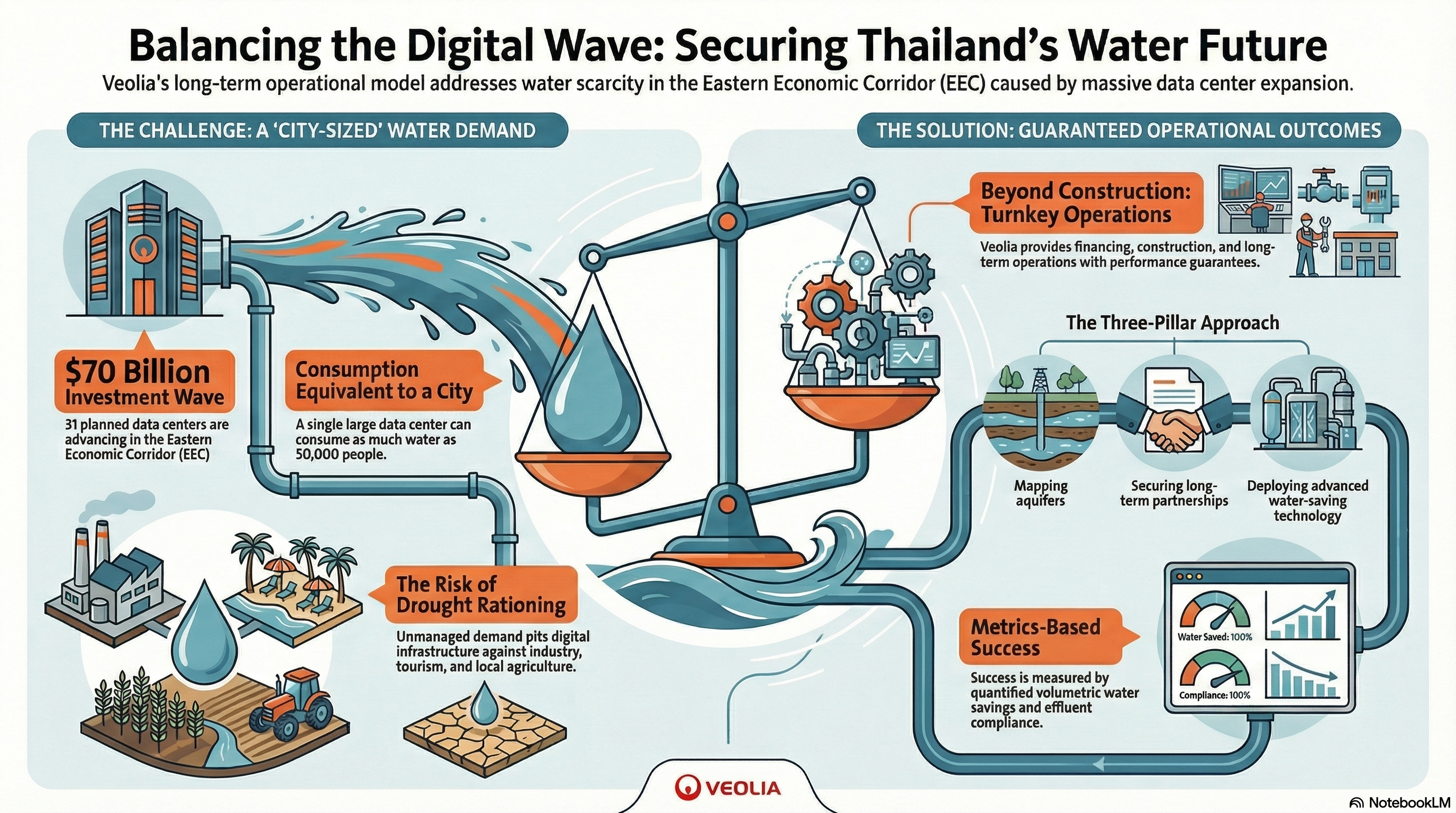
- Veolia is targeting Thailand’s Eastern Economic Corridor to address escalating water scarcity risks driven by rapid development.
- The region’s dense industry, tourism, agriculture, and a surge of hyperscale data centers are sharply increasing water demand.
- Without intervention, as seen during the 2019 drought, authorities could face zero-sum decisions over who receives water.
- Veolia’s strategy combines aquifer mapping, long-term partnerships to shrink data centers’ water footprints, and delivery via the group’s financing, build‑operate expertise, and technology portfolio.
- Differentiated by guaranteed water savings and compliant effluent under a turnkey model, Veolia measures success by water saved amid an influx of ~31 data centers (~US$70B), some using the water of a 50,000‑person city.
Veolia is moving to address water scarcity as a wave of new data centres strains shared resources across Thailand’s industrial east. The company aims to map aquifers, lock in long‑term operating partnerships with data centre operators and deliver projects using its financing and execution capacity. They are targeting measurable reductions in water consumption as 31 planned facilities together valued at about US$70 billion advance in the Eastern Economic Corridor. The plan is framed as a way to prevent drought‑time rationing that pits industry, tourism and agriculture against digital infrastructure.
“We are definitely looking at tackling some of the major environmental challenges we have in the region, and one of them is the water scarcity threat in the Eastern Economic Corridor,” said Jerome Le Borgne, Country Representative (Thailand) and South East Asia Development Director at Veolia, told BackgroundBriefing.news.
EEC drought risk puts water on the critical path
The EEC—a cluster of provinces east of Bangkok—hosts dense industry, tourism and agriculture, and is now adding hyperscale data centres to the mix. Officials confronted painful trade‑offs during the 2019 drought; without intervention, similar conditions could force authorities “to choose who gets water and who does not.” Veolia’s approach is pitched as a practical buffer against Eastern Economic Corridor water scarcity, focusing on sources, demand and delivery: “We map the water bed in order to identify replenishment possibilities; we marry the data center by creating a long‑term relationship in order to minimize their water footprint; and we deliver using the power of the group, our execution capacity, and our vast portfolio of technology.”
Model: long‑term contracts with guaranteed outcomes
Le Borgne underscored that Veolia is not acting as an EPC contractor that “builds a plant and runs away,” but as an operator providing a full turnkey solution—from financing and construction to operations—with performance guarantees. “We guarantee the water savings you will have; we guarantee the compliance of your effluent and take a risk that you might not want to take initially.” The company’s thesis is that guaranteed outcomes can accelerate decisions by data‑centre developers wary of capex, compliance and reputational risks tied to Eastern Economic Corridor water scarcity.
Scale of demand: ‘city‑sized’ consumption
The investment wave includes roughly 31 data centres valued at about US$70 billion, with logos from global cloud providers in the mix. Some facilities will consume the equivalent daily water use of a city of 50,000 people—a scale that, if unmanaged, could resemble adding a second‑largest city’s demand each time a large site goes live. Veolia argues this is the core problem its plan aims to solve: coordinating supply augmentation, reuse and efficiency at site level to keep aggregate draw within sustainable limits as Eastern Economic Corridor water scarcity intensifies during dry seasons.
Measuring success: water saved, not visibility
“The success is quite clear. Success is measured by the water we are saving,” said Le Borgne. He added that the aim is to be operationally unobtrusive “success is when people do not know that you are there”—but transparent about quantified outcomes, a stance aligned with developers’ and lenders’ need for hard metrics in an era of water‑related ESG scrutiny. Progress on Eastern Economic Corridor water scarcity will therefore be tracked in volumetric savings, effluent‑compliance rates and drought‑resilience indicators tied to each long‑term contract.
More stories: Evonik’s new alkoxide plant in Singapore boosts regional chemical supply chain
About the speaker:
Jerome Le Borgne
Country Representative (Thailand) and South East Asia Development Director
Veolia
Jerome Le Borgne, Country Representative (Thailand) and South East Asia Development Director at Veolia, leads growth and strategy in water, waste, and energy services across Thailand and ASEAN. He is a regional executive with over 20 years’ experience, managing P&L, market expansion, partnerships, and delivery of long‑term infrastructure for industrial and public clients.
He previously served as SUEZ Country Manager in Thailand and Project Development Director for Southeast Asia, after leading DP CleanTech’s sales across Southeast Asia, Australasia, and Africa. Earlier, he launched ETNA’s Shanghai office after consulting for the French Federation of Mechanical Industry, and is based in Bangkok today.
5W1H summary:
| What |
|
| How |
|
| Why |
|
| Who |
|
| Where |
|
| When |
|
FAQs:
What problem is Veolia addressing in Thailand’s Eastern Economic Corridor (EEC)?
Veolia is targeting escalating water scarcity in the EEC—an industrial region east of Bangkok—where growing demand from industry, tourism, agriculture and a surge of new data centres risks straining limited water resources, especially during droughts like in 2019.
Why is water scarcity intensifying in the EEC now?
The EEC is adding a wave of data centre investments to already heavy water users, making drought periods more likely to force hard trade-offs over allocation unless new conservation, reuse and supply measures are implemented.
What is Veolia’s three-part strategy to mitigate the issue?
Veolia plans to map the water bed to identify replenishment options, form long-term partnerships with data centres to minimise their water footprint, and deliver solutions using the group’s financing, build-operate capabilities and broad technology portfolio.
How will Veolia work with data centre operators in the EEC?
The company aims to “marry” data centres via long-term operating relationships that focus on reducing water intake, improving reuse and ensuring effluent compliance, backed by measurable performance guarantees.
How does Veolia differentiate itself from EPC contractors?
Unlike EPC firms that build and exit, Veolia offers a turnkey model—financing, building and operating assets—while guaranteeing water savings and regulatory compliance, and assuming risks that asset owners may not want to take initially.
How will success be measured for these initiatives?
Success will be quantified primarily by the volume of water saved and by maintaining compliant effluent, with the broader objective of avoiding drought-time rationing across competing users in the EEC.
What is the scale of data centre growth and its water impact?
The EEC is seeing about 31 data centres valued around US$70 billion; some facilities could consume water comparable to a city of 50,000 people if left unmanaged.
Who are the key stakeholders affected by these measures?
Stakeholders include hyperscale cloud providers building in Thailand’s EEC, local industries, tourism and agriculture sectors, and communities that rely on shared water resources across the region.
When is action needed and what is the time horizon?
Action is already underway to align with the current investment wave, with urgency heightened during dry seasons and future droughts, informed by lessons from the 2019 event.
Transcript of the interview:
At Veolia, we are definitely looking at tackling some of the major environmental challenges we have in the region. One of them we are focusing on right now is the water scarcity threat in the Eastern Economic Corridor in Thailand.
If you go to the Eastern Economic Corridor, which is a group of provinces east of Bangkok, you will find dense industrial areas, tourism, and agriculture. All of these are already heavy water consumers, and now we are adding a major boom in data center investment on top of that.
This means if we do nothing during a drought like the one in 2019, we will have to choose who gets water and who does not. This is a major issue for everyone in the region, and this is where Veolia steps in by proposing three things:
- We map the water bed in order to identify replenishment possibilities.
- We marry the data center by creating a long-term relationship in order to minimize their water footprint.
- We deliver using the power of the group, our execution capacity, and our vast portfolio of technology.
And what would make people pick Veolia rather than any other treatment?
There is a uniqueness in what we do and in our business model. We are not an EPC contractor or a company that builds a plant and runs away.
We are a company that provides a full turnkey solution from financing and building to operating, and we guarantee the water savings you will have. We guarantee the compliance of your effluent and take a risk that you might not want to take initially.
How will you then measure the success of these? Success is when people do not know that you are there, isn’t it?
The success is quite clear. Success is measured by the water we are saving.
The wave of investment in the Eastern Economic Corridor today involves around 31 data centers valued at seventy billion dollars. You have all the big names like Google, Amazon, Microsoft, and Tencent.
Some of those data centers will consume the equivalent of a city of 50,000 people. It is as if the second largest city was growing by 20 per cent each time we built one.
These are going to create major issues if this is not tackled. The first and key recipe for success is the amount of water we are able to save.