

Overview:
- Gurin Energy is addressing Singapore’s green energy gap—given a grid powered ~95% by natural gas, limited rooftop solar, and immature alternatives—by enabling cross-border renewable imports.
- Their strategy centers on building a large-scale solar plus battery project in Indonesia (roughly the size of 8,000 football fields), partnering with Singapore customers like data centres, and investing in regional clean energy infrastructure.
- Execution progress includes securing one of seven EMA conditional import licenses, developing a strong regional partner network, and obtaining over 90% of the required land.
- The project mobilizes about USD 5 billion in investment to create Indonesian jobs, catalyze local manufacturing, and strengthen a cross-border renewables supply chain.
- Long-term outcomes target Singapore’s decarbonisation and 6 GW of renewable imports by 2030, broader industrial benefits for Indonesia, and advancing the ASEAN Power Grid vision toward a more self-sufficient, greener region.
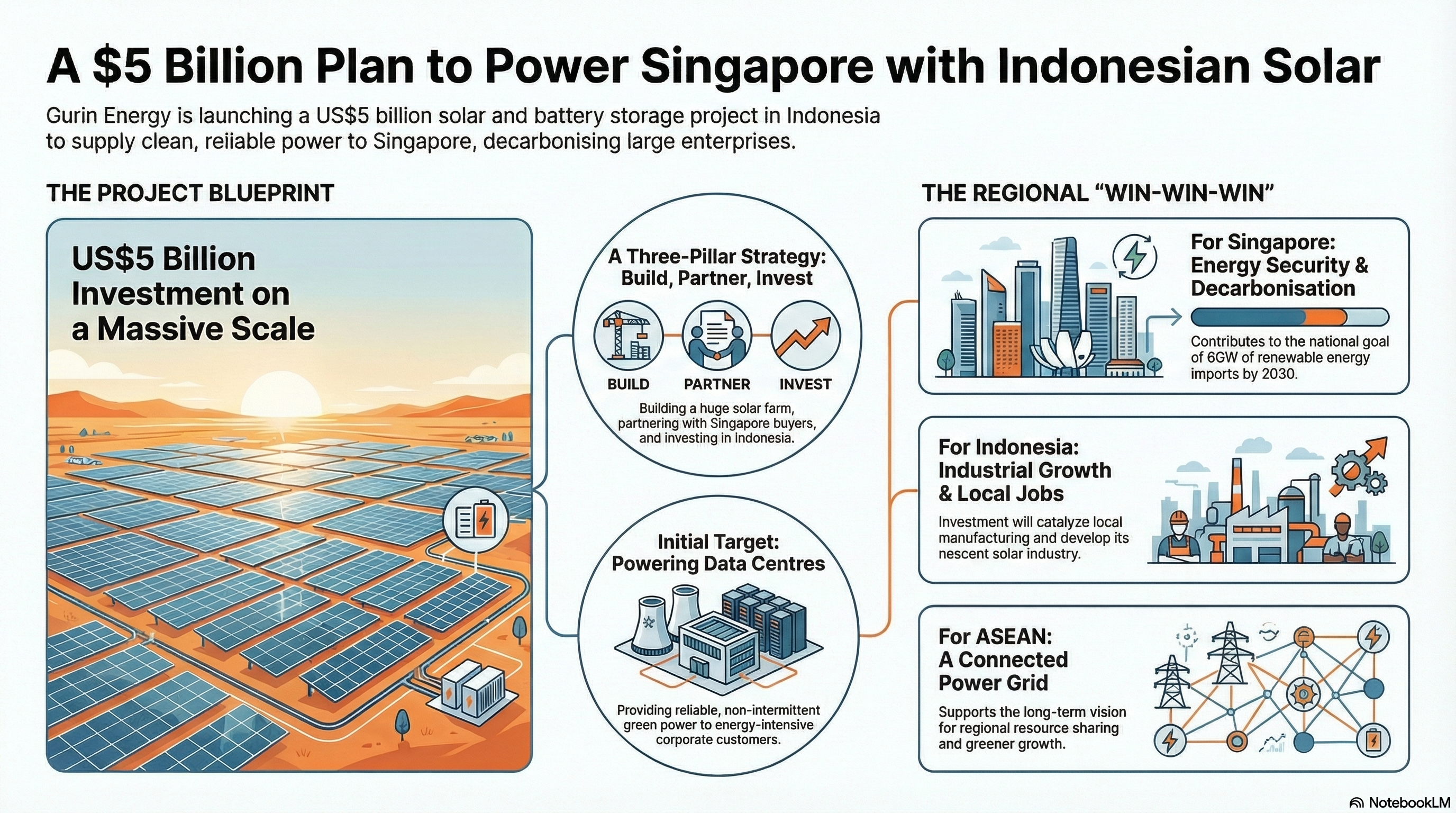
Gurin Energy is advancing cross-border renewable energy imports to address Singapore’s heavy reliance on natural gas, unveiling a utility-scale solar and battery energy storage project in Indonesia backed by US$5 billion and designed to supply firm green power to enterprise customers such as data centres.
Build–Partner–Invest: the project blueprint
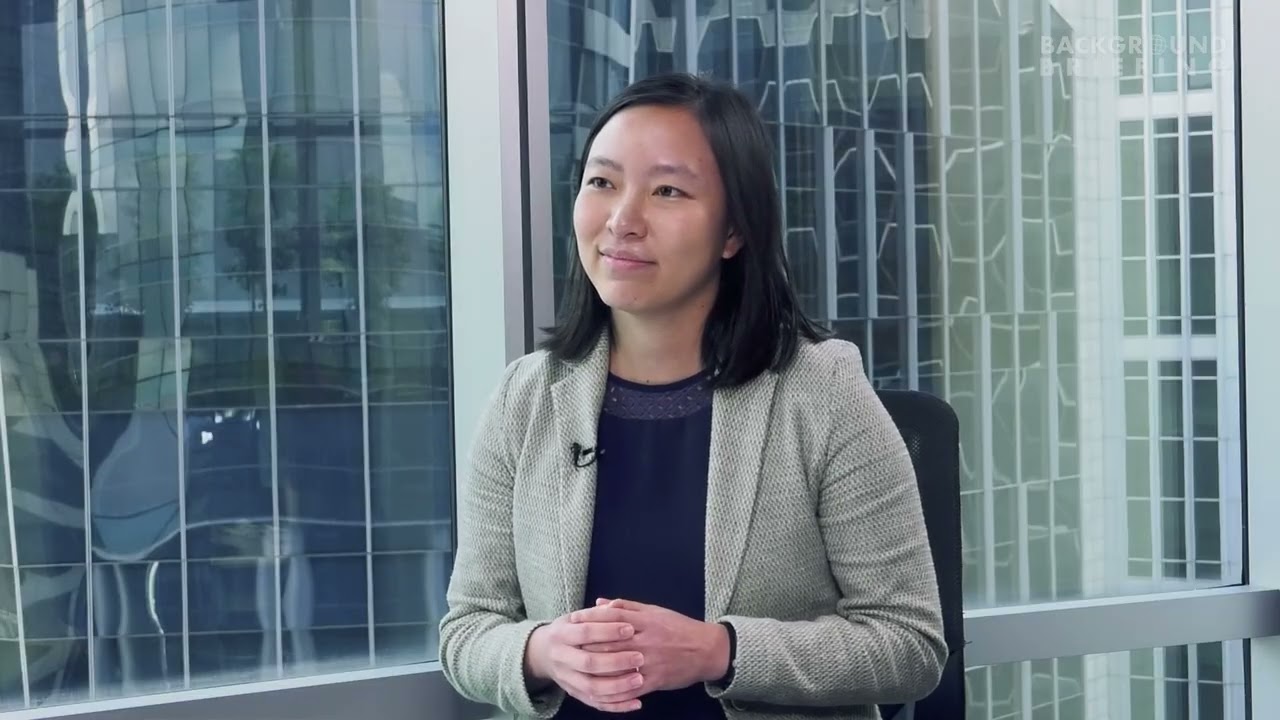
The company’s strategy rests on three pillars—building, partnering, and investing—with construction centred on a solar‑plus‑BESS facility “just across the border” and spanning roughly 8,000 football fields of land. “We are building a very large solar and battery energy storage plant in Indonesia just across the border,” Kar Min Lim, Managing Director, Strategy, told BackgroundBriefing.news. Gurin Energy is simultaneously partnering with Singapore buyers seeking bankable clean energy and investing in Indonesia’s clean energy infrastructure and industry to anchor a resilient regional supply chain.
Licensing, land and execution progress
Lim says the company has secured one of seven conditional licences released by Singapore’s Energy Market Authority (EMA) to enable cross-border renewable energy imports, alongside a “strong network of partners” spanning governments, companies, contractors and financiers. Lim adds it has secured more than 90% of the required land, with local teams on the ground familiar with conditions, stakeholders and markets. “We are making a lot of progress in these last couple of years. We are stepping towards realising this potential for clean energy import into Singapore,” Lim said.
Customers and use case: data centres first
With domestic solar constrained and emerging options like hydrogen, ammonia or carbon capture not yet mature for wide‑scale use, Gurin Energy is positioning cross-border renewable energy imports as an immediate solution for corporates that need credible decarbonisation without sacrificing reliability. The firm highlights data centres as early adopters, using battery‑backed imports to manage intermittency and deliver non‑intermittent power profiles.
Capital deployment and industrial impact in Indonesia
Gurin Energy plans to deploy about US$5 billion from the project into development activities that create jobs and develop Indonesia’s nascent solar industry. The investments extend beyond generation assets, aiming to catalyse local suppliers and manufacturers and encourage the setup of factories in Indonesia—building a cross‑border supply chain that serves both Singapore imports and Indonesia’s domestic renewable push.
Targets and regional outcomes
Longer‑term, Gurin sees three beneficiaries: Singapore, Indonesia and ASEAN. For Singapore, the project aims to contribute to decarbonisation and the government target of 6GW of renewable energy imports by 2030, framed by the company as about 75% of today’s energy consumption. For Indonesia, Gurin expects the manufacturing and infrastructure investments to deepen industrial capacity. Regionally, the effort supports the long‑standing ASEAN power grid vision, with cross-border renewable energy imports enabling resource sharing, security and greener growth. “Longer term, there are three main outcomes and beneficiaries of this project: Singapore, Indonesia, ASEAN and the region as a whole,” Lim said.
More stories: BNM fast-tracks digital asset innovation hub to shield retiree funds
About the speaker:
Lim Kar Min
Managing Director, Strategy
Gurīn Energy
Kar Min Lim, Managing Director, Strategy at Gurīn Energy, is a leader in renewable energy strategy and business development.
Previously a Partner at Boston Consulting Group, Lim advised utilities, governments and corporates on green growth, energy storage, low-carbon technologies and decarbonisation pathways, including regional energy modelling with PLEXOS.
Lim built and led diverse teams across the United States, Australia and Southeast Asia, earning a Generative Leader Award for developing high-performing talent.
Lim holds a Bachelor’s in History from Princeton University, studied at Christ Church, University of Oxford, and speaks Chinese and English at native level and Spanish at professional level.
FAQs:
What challenge is Gurin Energy addressing in Singapore’s power sector?
Gurin Energy is tackling Singapore’s clean energy gap, where about ninety-five per cent of electricity comes from natural gas and domestic rooftop solar is insufficient to meet national demand; the company proposes cross-border renewable energy imports as a practical solution.
Why not rely on domestic solar or emerging technologies like hydrogen and carbon capture?
Land and rooftop constraints make domestic solar inadequate for Singapore’s total needs, and options such as hydrogen, ammonia, or carbon capture are not yet mature enough for wide-scale deployment; hence the focus shifts to regional renewables available in neighbouring countries.
What is Gurin Energy building, and where?
Gurin Energy is building a very large solar plant paired with battery energy storage in Indonesia just across the border, occupying land roughly equivalent to 8,000 football fields—space that is not available in Singapore.
How much is being invested and what are the economic benefits in Indonesia?
The project involves about USD 5 billion in investment for development, creating jobs for Indonesians and helping to grow Indonesia’s nascent solar industry by partnering with suppliers and manufacturers and encouraging factory setups to support cross-border projects and domestic demand.
Who are the target customers for this cross-border renewable energy?
Gurin Energy is partnering with Singapore-based customers seeking green power, with data centres highlighted as a key segment requiring reliable, battery-backed clean energy to meet stakeholder expectations and decarbonisation goals.
What regulatory progress has Gurin Energy achieved?
The company has secured one of seven conditional licenses issued by Singapore’s Energy Market Authority to enable cross-border renewable energy imports, and reports a strong regional network plus more than ninety per cent of the required land already secured on the ground.
How does the project contribute to Singapore’s energy targets?
According to Gurin Energy, the project supports Singapore’s decarbonisation efforts and the government target of 6 gigawatts of renewable energy imports by 2030, which the company contextualises as roughly seventy-five per cent of today’s energy consumption.
What are the longer-term regional outcomes envisioned?
The initiative aims to benefit Singapore, Indonesia, and ASEAN by advancing the long-discussed ASEAN power grid, enabling shared renewable resources, enhancing self-sufficiency, and supporting greener economic growth across the region.
5W1H summary:
| Label | Summary |
|---|---|
| What |
|
| How |
|
| Why |
|
| Who |
|
| Where |
|
| When |
|
Transcript of the interview:
Imagine you are a data centre in Singapore looking for green energy because your stakeholders and shareholders want it for a climate conscious world. You look at your options but cannot use the electric grid because in Singapore that is ninety-five per cent natural gas.
Buildings everywhere have some solar on rooftops, but it is definitely not enough to power all of Singapore’s energy needs. You cannot use domestic solar either.
You might get excited about future technologies like hydrogen, ammonia, or carbon capture, but those are not mature enough yet for wide-scale use. You look across our borders to neighbouring countries with hundreds of gigawatts of renewable energy potential that have the land, space, sun, and wind needed to power the region.
That is what Gurin Energy is doing by tackling Singapore’s clean energy crisis with cross-border renewables. Our approach involves three main things:
- Building
- Partnering
- Investing.
We are building a very large solar and battery energy storage plant in Indonesia just across the border. For context, the size of this is about 8,000 football fields, which is a large amount of land definitely not available in Singapore.
We are partnering with customers in Singapore looking for green energy to supply their needs, such as data centres.
We are investing in Indonesia’s clean energy infrastructure and industry, not just supplying energy to Singapore.
We are investing about USD 5 billion from our project alone into project development. This is creating jobs for Indonesians and developing Indonesia’s nascent solar industry.
You obviously have only been around for four years or so. What puts you in the right position to be the right partner in this project?
We have only been around for four years, but we have achieved a lot in that amount of time.
- We have secured one of seven conditional licenses released by the Energy Market Authority of Singapore to enable these cross-border renewable energy imports.
- We have a strong network of partners in the region, including governments, companies, contractors, and financiers committed to an interconnected ASEAN power grid.
- We have a strong team on the ground familiar with local conditions, stakeholders, and markets who have secured more than ninety per cent of the required land.
We are making a lot of progress in these last couple of years. We are stepping towards realising this potential for clean energy import into Singapore.
And longer term, what is the goal or the outcomes that you are gunning for?
Longer term, there are three main outcomes and beneficiaries of this project.
- Singapore
- Indonesia
- ASEAN and the region as a whole.
- For Singapore, our project will help to achieve our decarbonisation targets and the government target of 6 gigawatts of renewable energy imports by 2030. For context, that is about seventy-five per cent of today’s energy consumption in Singapore.
- We are contributing to Indonesia by attracting investments not just in construction and jobs, but also by partnering with suppliers and manufacturers. They also invest in setting up factories in Indonesia to build a supply chain that benefits cross-border projects and Indonesia’s domestic renewable energy industry.
- It is for the ASEAN region. The dream of the ASEAN power grid has been around since the 1980s and we are seeing more action today.
This is a pioneering effort we are proud to contribute to as a vital first step in realising an interconnected power grid. This allows ASEAN to share renewable energy resources, become more self-sufficient, and green our economies.