

Overview:
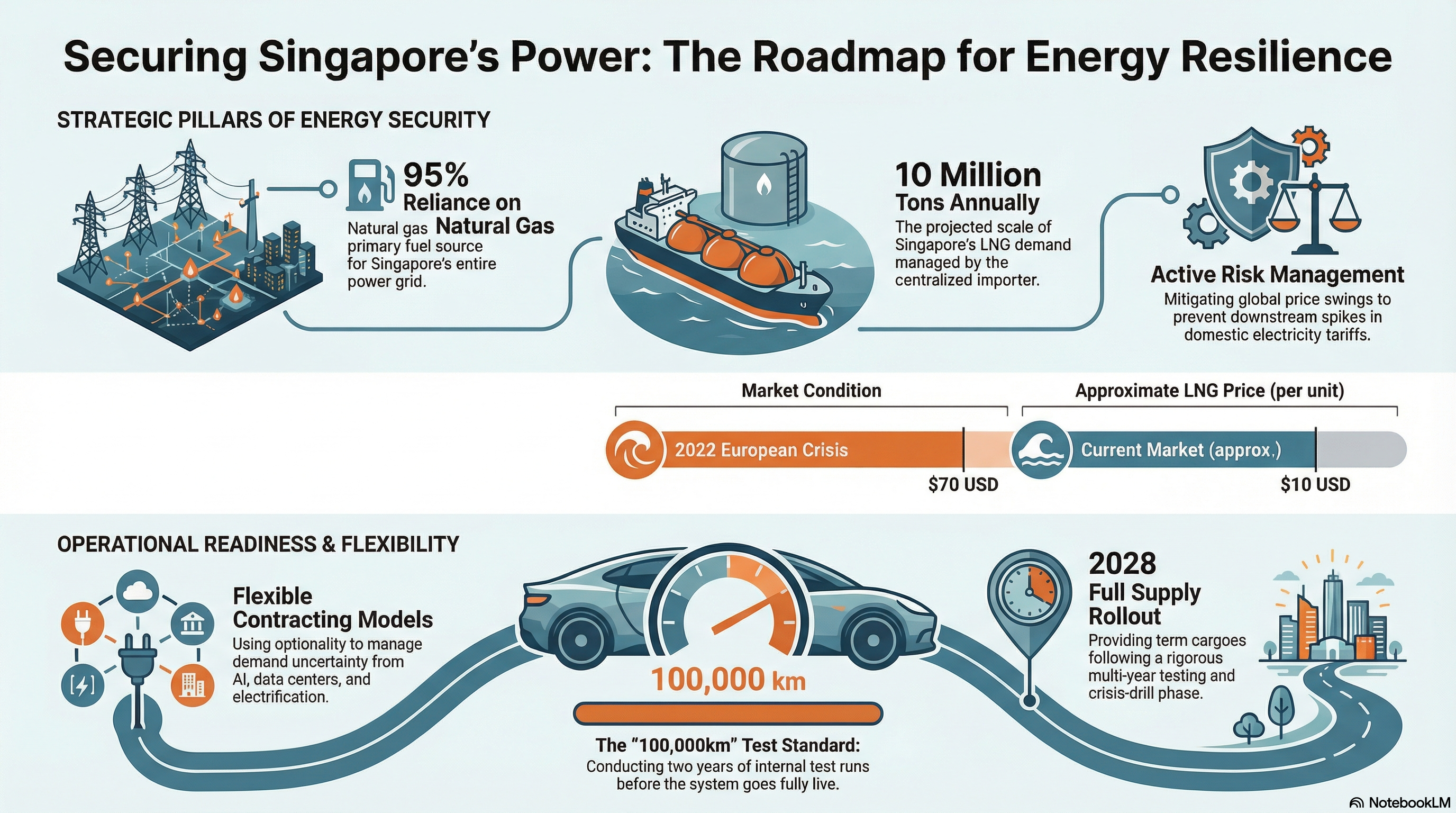
- Singapore GasCo plays a central role in ensuring Singapore’s energy security by managing gas imports through smart procurement, active risk management, and operational excellence.
- Smart procurement involves adapting contracting strategies to fluctuating national gas demand influenced by factors such as electrification, data centers, AI growth, and potential electricity imports.
- Active risk management is essential to prevent volatility—such as the 2022 gas price spike—from cascading into higher electricity costs for consumers.
- Operational excellence focuses on building robust systems, processes, and crisis‑response capabilities so the organization can function smoothly as it matures.
- Over the next two years, Singapore GasCo will conduct extensive testing, simulations, and system development to ensure full readiness before delivering term cargos in 2028.
Singapore GasCo, the government-formed centralised gas importer, is tightening its operational and risk frameworks as Singapore’s demand for liquefied natural gas (LNG) approaches 10 million tons annually, a load equivalent to one‑seventh of the world’s largest LNG trader. The company’s mandate is to secure long‑term energy resilience at a time when volatility in global gas markets continues to shape domestic electricity prices.
“One of the key roles for Singapore GasCo is to ensure energy security and resilience, Singapore is powered by 95 per cent natural gas,” Alvin Chang, Chief Operating Officer, told BackgroundBriefing.news.
Smart Procurement Amid Shifting Demand
Singapore’s gas demand is expected to fluctuate sharply as electrification accelerates across transport, data centres and AI‑driven infrastructure, even as the country prepares to import electricity from neighbouring systems. Chang said this dual trend makes demand planning “inherently uncertain,” and Singapore Gas Co is responding with flexible contracting, optionality in supply terms and the capability to manage both excess and shortfall cargoes.
“If we do not do this in a smart way, there will always be a risk of excess cargos or under-procurement,” he said.
Active Risk Management to Avoid Price Shocks
A central pillar of the company’s strategy is active risk management, especially as Singapore GasCo scales its portfolio to 10 million tons a year. Chang warned that unmanaged exposure could amplify global price swings, noting that gas prices hit US$70 during the 2022 European crisis — compared with around US$10 today — with direct downstream effects on Singapore’s electricity tariffs.
“If that is not managed well, the impacts of higher gas prices being procured will translate down into electricity prices,” he noted.
Operational Readiness Before 2028 Rollout
Although only six months old, Singapore GasCo is building operational infrastructure equivalent to a fully road‑tested system well before supplying term cargoes by 2028. Internal test runs, user acceptance tests and crisis‑management drills will be conducted over the next two years.
“We will start doing test runs… to ensure that the car has driven 100,000 kilometres before we actually start running it,” Chang said.
He stressed that the company is not competing with other market licensees; instead, it will function as the nation’s centralised procurement entity to stabilise supply for power generation.
More stories: US$5b investment in Indonesia’s renewables supply chain to power Singapore, says Gurin Energy
About the speaker:
Alvin Chang
Chief Operating Officer
Singapore GasCo
Alvin Chang, Chief Operating Officer at Singapore GasCo, is a seasoned C‑suite leader with more than 20 years of experience across commodities, financial markets, and risk management.
His career spans senior roles in global energy and financial institutions, where he built high-performing businesses, led digital transformation, and engineered advanced risk governance frameworks that supported sustained growth and organizational resilience.
5W1H summary:
| W / H | Summary |
|---|---|
| What |
1. Summarize interview into publishable article. 2. Create overview and biography snippet. 3. Focus on Singapore energy security. |
| How |
1. Applied Business Times style guidelines. 2. Used bolded bullets and subheadings. 3. Included quotes, figures, milestones. |
| Why |
1. Inform investors on Singapore energy security. 2. Clarify procurement, risk management strategies. 3. Support policy and market understanding. |
| Who |
1. Singapore Gas Co leadership. 2. Alvin Chang, Chief Operating Officer. 3. BackgroundBriefing.news editorial team. |
| Where |
1. Singapore natural gas market, ASEAN. 2. Centralised LNG importation in Singapore. 3. Online publication for Asia-Pacific readers. |
| When |
1. Company currently six months old. 2. Testing over the next two years. 3. Term cargo deliveries expected 2028. |
FAQs:
What is the primary role of Singapore GasCo?
Singapore GasCo acts as Singapore’s centralised gas importer, ensuring secure and reliable LNG supply for national power generation.
How does Singapore GasCo ensure energy security?
The company applies three pillars—smart procurement, active risk management, and operational excellence—to stabilise supply and manage market volatility.
Why is smart procurement important for Singapore?
Singapore’s LNG demand fluctuates due to electrification trends, data centre growth, and potential electricity imports, making flexible procurement essential.
What risks arise from global gas price volatility?
Sharp price spikes, such as the jump to US$70 during the 2022 European gas crisis, could directly increase Singapore’s electricity prices if unmanaged.
How is Singapore GasCo preparing its operations before 2028?
Over the next two years, the company will conduct system builds, test runs, simulations, and crisis‑response exercises to ensure full readiness.
Is Singapore GasCo competing with existing licensed gas players?
No—licensees continue their functions while Singapore Gas Co serves as the central importer responsible for procuring gas for national power needs.
Why does LNG demand uncertainty pose challenges?
Demand may surge due to electrification or fall if regional electricity imports arrive early, requiring dynamic procurement strategies.
What operational systems are being developed?
Standard operating procedures, business continuity plans, and crisis response frameworks are being established to ensure seamless organisational performance.
Transcript of the interview:
Singapore GasCo was formed by the government to centralize the importation of gas into Singapore. Singapore is powered by 95 per cent natural gas.
The role for Singapore GasCo is important. One of the key roles for Singapore GasCo is to ensure energy security and resilience.
Singapore Gas Co does this in three ways.
- Smart procurement.
- Active risk management.
- Operational excellence.
Smart procurement means that if you think about the demand of gas in Singapore, the country consumes about 10 million tons of LNG. To give some context, the biggest LNG trader in the world, Shell, trades about 70 million tons, so Singapore as a system consumes one-seventh of the largest trader in the world.
That is not a small amount. The demand for energy is not constant.
Many things affect the demand and therefore the procurement planning. With the electrification of car fleets, data centers, and AI, demand can shoot up.
When the demand numbers go up, the procurement strategy has to change. On the flip side, Singapore is on this journey to import electricity from neighboring countries.
If the importation of power comes in earlier, demand for LNG will drop. This demand uncertainty makes procurement a little bit more challenging.
If we do not do this in a smart way, there will always be a risk of excess cargos or under-procurement. We do this in three ways.
- Flexible contracting.
- Having optionalities on our contracts.
- The ability to deal with excess cargos and what we do when we are over or under-contracted.
The second pillar is active risk management. Once Singapore GasCo starts to grow its portfolio to 10 million tons a year, that is a huge portfolio.
If you do not manage this well, the risk of this going belly up is high. During 2022, in the midst of the European gas crisis, gas prices shot up to about 70 US dollars.
For context, today it is about 10 US dollars. Imagine what that could do to Singapore electricity prices.
If that is not managed well, the impacts of higher gas prices being procured will translate down into electricity prices. That will mean a cup of tea as you turn on the kettle or using the air conditioning when the weather is hot is going to get costly.
Having active risk management as part of managing risk for Singapore GasCo is key. The third pillar around how we ensure energy security is through operational excellence.
Singapore GasCo is young at six months old. As a startup, as we build different building blocks of a car, we have the wheels, the chassis, and the engines being built.
How do you know that when you turn on the engine, the car is going to run smoothly? It makes sense for us to start stitching up all these pieces so that the car is fully operational.
We have built standard operating procedures and business continuity plans. We will do emergency response and crisis management exercises so that the team as a whole can function in a coherent manner.
Through these three ways—smart procurement, active risk management, and operational excellence—Singapore GasCo can ensure energy security and resilience for Singapore.
As you said, there are other licenses; what is unique about Singapore Gas Co?
We are not competing with the licensees. Singapore Gas Co is the centralized importer for Singapore.
The licensees will continue to do what they are supposed to do. For Singapore Gas Co, our main aim is to procure gas for Singapore for power generation.
You mentioned operational excellence, so presumably you have some data points around how you are going to meet those KPIs. Are there any others?
The proof is in the pudding. We do not wait for the car to start running before we figure out something is wrong.
Between now and the time where Singapore GasCo starts delivering term cargos into Singapore, which is projected to be in 2028, we have about two years. Within these two years, we will start building up our systems.
We will start doing test runs, user acceptance tests, and simulation runs within Singapore GasCo. This is to ensure that the car has driven 100,000 kilometers before we actually start running it.