

Overview:
- Singapore GasCo is doubling its staff strength—allocating about half of its budget to people costs covering recruitment, development, and workplace support.
- Given its niche purpose, Singapore GasCo is looking for talent with specialized expertise.
- Success for Singapore GasCo is defined by building an engaged, motivated workforce that finds meaning in contributing to supply stability and competitive pricing.
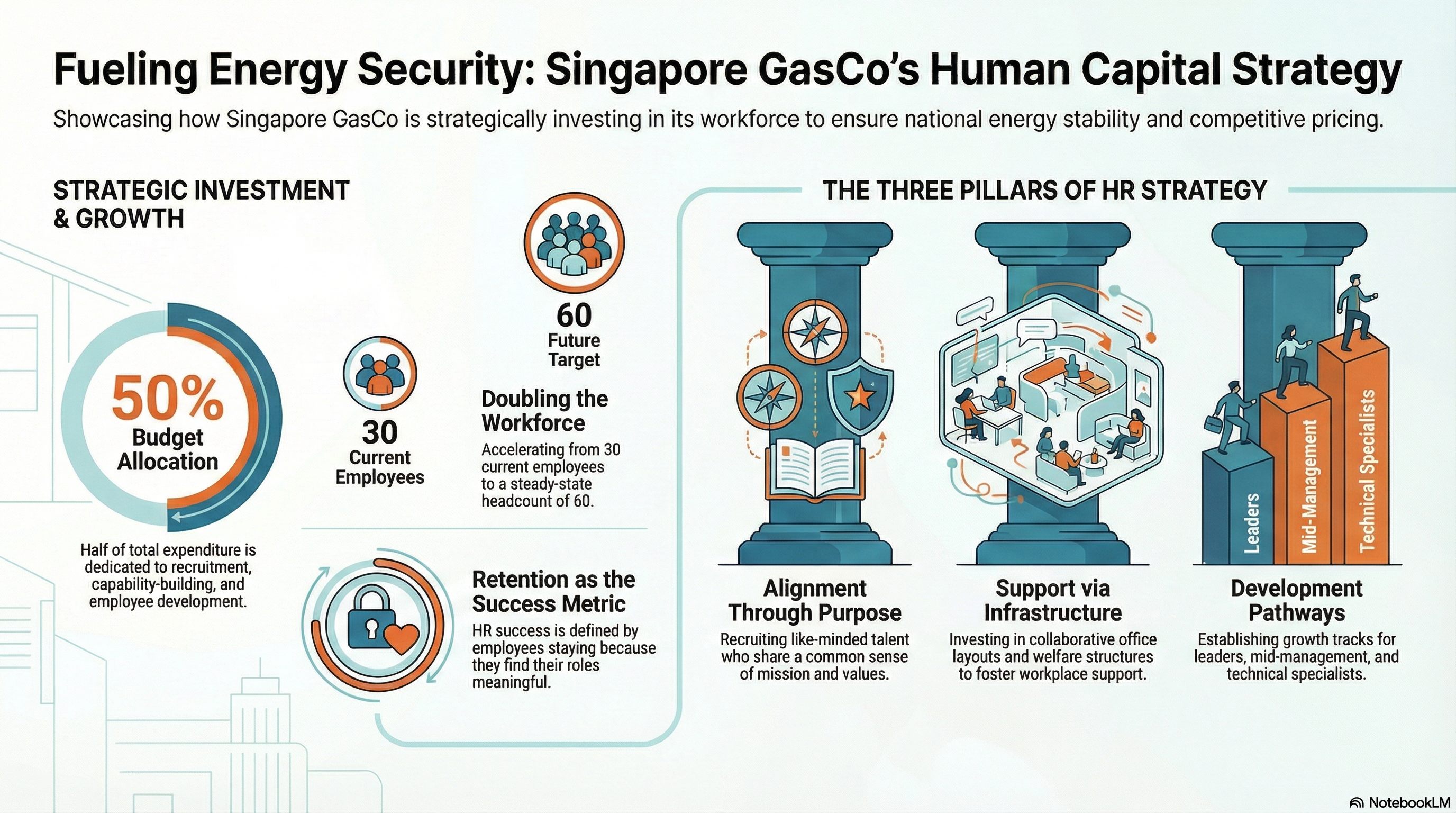
Singapore GasCo is directing about half of its total budget into people‑related costs, as the newly established energy entity accelerates efforts to build organisational capability to support its core mandate of supply stability and competitive pricing. The company expects to grow its workforce from 30 today to a steady‑state headcount of around 60.
Building alignment around purpose
The company is placing early emphasis on cultural alignment to ensure new hires share a common sense of mission. “We built a clear corporate brand with a clear purpose and values to recruit like‑minded talent who are clear on our focus,” Joyce Loh, Director of HR and Corporate Services, told BackgroundBriefing.news. She described alignment as central to the start‑up phase of its operations. “[It is] very important for us that they feel part of that purpose,” Loh added.
Beyond purpose‑setting, the organisation is investing in physical space and welfare intended to foster collaboration and workplace support. This includes intentionally designed office layouts, engagement initiatives and foundational HR systems intended to support employees as the organisation scales.
Strengthening people infrastructure to support supply stability
The company’s early HR strategy is structured around three pillars—alignment, support and development—all of which Loh says are essential to the organisation’s long‑term ability to maintain supply stability. “We want to build a supportive environment both physically and through welfare and engagement,” she said. This includes development pathways for leaders, mid‑management and technical specialists.
By directing roughly 50 per cent of total expenditure towards recruitment, capability-building and employee development, Singapore GasCo aims to accelerate the formation of a competent and motivated workforce capable of meeting future operational demands.
Retention and engagement as measures of success
Loh said the organisation defines HR success in straightforward terms: people staying because they find their roles meaningful. “In the HR world, success looks like people being motivated to stay in the job,” she said.
As Singapore GasCo progresses toward its planned steady‑state workforce size of about 60, it continues to emphasise the link between people capability and the national imperative of stable, competitively priced gas supply.
More stories: Developing nations face unique hurdles in energy transition, says Standard Chartered
About the speaker:
Joyce Loh
Director of HR and Corporate Services
Singapore GasCo
Joyce Loh, Director of HR and Corporate Services at Singapore GasCo, is an experienced HR and communications leader with a strong background in talent acquisition, change management, and human capital development.
She has built her career across sectors including executive search, healthcare, and education, holding senior roles such as HR Director and Head of Talent Acquisition at NTUC First Campus, as well as Senior HR Manager at MOH Holdings. Joyce holds a Graduate Diploma in Human Resource Management from Southern Cross University and a Computer Engineering degree from Nanyang Technological University, bringing both strategic and technical depth to her leadership approach.
5W1H summary:
| W/H | Summary |
|---|---|
| What |
1. HR strategy at Singapore GasCo. 2. Focus on people capability. 3. Interview reformatted for clarity. |
| How |
1. Allocate 50% people budget. 2. Build alignment, support, development pillars. 3. Create collaborative office spaces. |
| Why |
1. Ensure supply stability in Singapore. 2. Achieve competitive pricing for consumers. 3. Boost engagement and retention. |
| Who |
1. Singapore GasCo leadership and HR. 2. Employees: leaders, managers, specialists. 3. Like-minded talent in Singapore. |
| Where |
1. Singapore, ASEAN energy market context. 2. Collaborative offices in Singapore. 3. Corporate culture initiatives in Singapore. |
| When |
1. Startup phase, first year milestones. 2. Headcount 30 now, target 60. 3. Steady state expected within ramp-up. |
FAQs:
What are Singapore GasCo’s main priorities during its startup phase?
Singapore GasCo is focused on alignment, building a supportive environment, and developing its people across leadership, mid-management, and specialist roles.
Why is the company allocating about half of its budget to people costs?
The investment supports recruitment, employee development, and workplace infrastructure to ensure supply stability and competitive pricing.
How is Singapore GasCo creating alignment among its employees?
The company established a clear purpose, values, and corporate brand to attract and retain like‑minded talent aligned with its mission.
What steps has the company taken to build a supportive work environment?
Singapore GasCo intentionally designed collaborative office spaces and implemented welfare and engagement initiatives to support teams.
What makes Singapore GasCo attractive to potential hires?
The organisation offers a purpose-driven culture, a small and focused team structure, and roles built around meaningful national impact.
How does Singapore GasCo define success from an HR perspective?
Success is measured by employee motivation, retention, and creating an engaged community that finds purpose in its work.
What is the expected workforce size as Singapore GasCo grows?
The company currently has about 30 employees and aims to reach a steady‑state workforce of around 60.
How does employee development support the company’s mission?
Targeted development for leaders, managers, and specialists strengthens organisational capability essential for supply stability.
Transcript of the interview:
As Singapore GasCo starts up, one of the key things we want to tackle is the challenge of building people capability. As the first few hires, we want to ensure we look at three specific areas.
- Alignment: This involves getting people aligned to our shared purpose. We built a clear corporate brand with a clear purpose and values to recruit like-minded talent who are clear on our focus.
- Support: We want to build a supportive environment both physically and through welfare and engagement. We took intentional steps to build collaborative office spaces as we shaped the organization.
- Development: We put emphasis on developing our people at different stages. This includes leaders, mid-management, and specialists as we continue our work in progress.
This is where our headspace is to ensure a smooth start for Singapore GasCo, to fulfill our purpose of supply stability and competitive pricing, we have put about half of our budget into people costs. This investment covers recruitment, development, and building a supportive environment. We have reached thirty members in our first year and expect to reach a steady state of about sixty.
You mentioned that you are in the startup phase, which makes you quite unique, but what else do you offer for staff to join you? What other unique aspects can they get by joining Singapore GasCo versus any other company?
At steady state, Singapore GasCo is not going to be a very big organization. Our focus is making sure we have people who are aligned with our values and purpose and have the right expertise.
We focus our attention here so people attracted to us know exactly what they are in for. It is very important for us that they feel part of that purpose.
And what does success look like?
In the HR world, success looks like people being motivated to stay in the job. We want to build an engaged community where people see they are in a very meaningful space.
I have reformatted this interview to highlight the strategic focus on human resources and corporate culture at Singapore GasCo. Given that half of the budget is dedicated to people costs, would you like to explore how these recruitment and development efforts directly support their core mandate of supply stability?