

At a glance
Dennis Goh of Salt Investments Limited
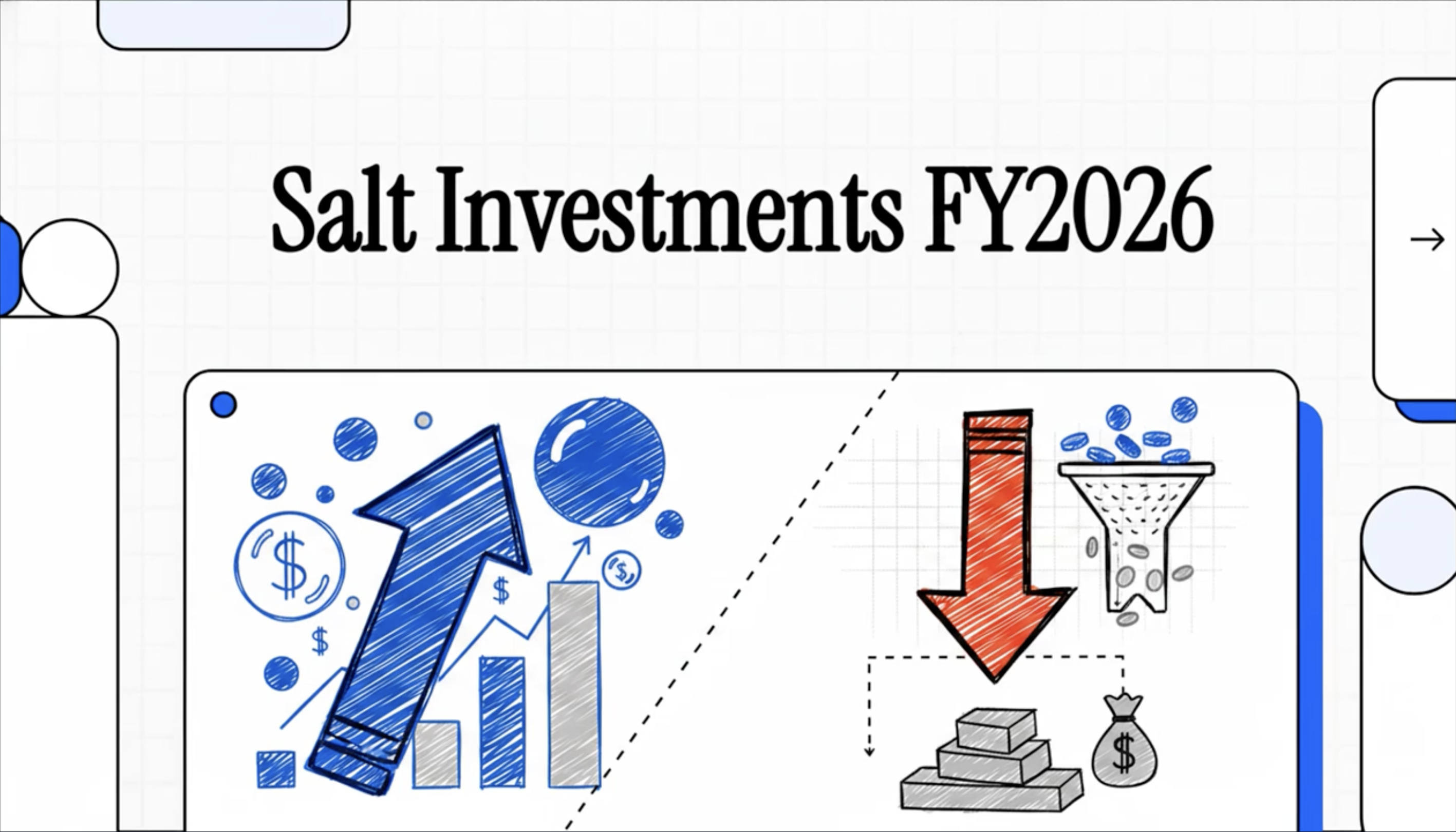
The company reported a paradoxical FY2026 financial result featuring an explosive 589% revenue surge alongside an eye-watering S$13.51 million net loss from massive balance sheet impairments
During the fiscal year 2026 reporting period ending March 31, which included a full-year contribution from Prosper Excel and a 10-month financial stub from TT Oil Singapore
Headquartered in Singapore, listed on the Singapore Exchange (SGX), and operating across global maritime shipping routes, including the Middle East, and expanding into newly targeted African territories
The massive net loss resulted from S$11.2 million in non-cash goodwill impairments and inherited liabilities. This intentional corporate restructuring effectively cleared the balance sheet decks for future profitability
Management expanded gross profit margins to 13.5% through operational efficiencies. They narrowed adjusted EBITDA losses by 70%, capitalised digital platform assets, and secured S$4.81 million through a post-year-end share placement
What Investors Need to Know About Salt Investments FY2026 Results
The FY2026 results for Salt Investments Limited present a striking paradox that demands a sophisticated reading of the balance sheet. On the surface, the headline figures are contradictory: an explosive 589% revenue surge to S14.69 million set against an eye-watering net loss of S13.51 million.
To the untrained eye, a loss of this magnitude following aggressive acquisitions might signal a sinking ship. However, for the strategic investor, the narrative is not one of failure, but of a massive structural cleanup. The deepening loss is largely a function of non-cash “accounting ghosts” and conservative valuations, while the underlying business shows unmistakable signs of an operational turnaround. FY2026 was the year Salt Investments chose to “clear the decks” to prepare for a leaner, digitally-driven future.
The 589% Revenue Surge is Only Half the Story
The leap in revenue to S14.69 million is mathematically impressive, reflecting the full-year contribution of Prosper Excel Engineering and a 10-month stub from TT Oil Singapore. Yet, the more significant indicator of business health is found in the 814% increase in gross profit, which climbed to S1.98 million.
Crucially, the gross profit margin expanded to 13.5% (up from 10.2% in FY2025). This margin expansion validates the quality of the acquisitions and indicates that the integrated entities are operating with greater efficiency than the legacy business. As CEO Dennis Goh noted, the “positive impact and performance improvement” of these acquisitions have provided the necessary scale to transition into the next phase of the Group’s growth strategy.
The S$11 Million Accounting Cleanup: Exorcising the “Ghosts”
The primary weight on the FY2026 bottom line was a S$11.2 million goodwill impairment. While visually jarring, these are non-cash charges required by SFRS(I) 1-36 that often mask actual business velocity.
For the strategic investor, the TT Oil impairment is particularly revealing of an “accounting ghost.” During the Purchase Price Allocation process, S$3.95 million in Expected Credit Loss provisions were recognized against pre-acquisition receivables (primarily involving PetroChina). Under accounting rules, this provision artificially inflated the goodwill on the balance sheet, which was then impaired when the independent valuer adopted a conservative Value-In-Use assessment. In short: this was an inherited liability, not an operational failure of FY2026.
The S$7.26 million impairment for Prosper Excel follows a similar logic of extreme conservatism. The independent valuer applied a post-tax WACC of 9.76% and purposely excluded future cash flows from initiatives like waste recycling and fuel bunkering because they were not fully operational by the March 31 reporting date. By front-loading these charges and adopting “more conservative growth and margin assumptions” than the original acquisition case, management has effectively purged the balance sheet of future earnings drag.
Visualizing the Core Turnaround: Revenue vs. Adjusted EBITDA
Stripping away the non-cash noise reveals the true operational signal. The Adjusted EBITDA, which excludes the goodwill impairment and current-year Expected Credit Loss provisions, shows a business rapidly approaching a tipping point.
| Metric (S$’000) | FY2025 | FY2026 | Change |
| Revenue | 2,133 | 14,691 | +589% |
| Adjusted EBITDA (Loss) | (3,506) | (1,054) | +70% Improvement |
This 70% narrowing of the Adjusted EBITDA loss is the most authentic metric for investors. It demonstrates that the Group’s core maritime services are stabilizing and scaling effectively.
Pivot to the Digital Horizon
Salt Investments is aggressively repositioning from a traditional marine services firm to a digitally-enabled maritime platform. The Group has capitalized S$4.0 million in intangible assets for the Salt-Lyte platform, but investors must distinguish between its components to predict future P&L impact:
- **S1.2 million for Licensing:** This carries a 5-year exclusivity period and will begin amortizing at approximately S240,000 per year once the platform is operational (expected in 12–18 months).
- S$2.8 million for Development: These are perpetual ownership rights with an indefinite life, meaning they will not drag on earnings through amortization but will be subject to annual impairment testing.
CEO Dennis Goh views this as the “next phase of enterprise value creation,” addressing critical financing and digitalization gaps that currently plague the maritime sector.
The Environmental Tailwind
The strategic collaboration with Mencast Holdings Ltd for integrated oily-waste management is more than a green initiative; it is a regulatory arbitrage play. By aligning with tightening IMO and MARPOL requirements, Salt is turning a mandatory compliance burden for ship owners into a high-value revenue stream. The Group’s ability to recover and sell recycled fuel oil provides a counter-cyclical hedge against global oil supply volatility.
Geopolitical Friction and Strategic De-risking
FY2026 was not without friction. The Iran-Hormuz conflict disrupted Middle East shipping routes, impacting TT Oil’s lubricant distribution volumes. However, the Group’s response has been a textbook example of de-risking the supply chain. Through the Sinova Group/EUROTEC partnership, Salt is expanding into African territories (Zimbabwe, Mozambique, Angola, and Congo). This geographic diversification pivots the business away from regional geopolitical instability and toward emerging markets with high growth potential.
A Clean Slate for FY2027
The “accounting ghosts” of previous acquisitions have been exorcised, and the balance sheet has been reset using high WACC benchmarks (9.76% for Prosper and 8.61% for TT Oil) that leave little room for further negative surprises.
Post-year-end, the company raised S4.81 million through a share placement, significantly strengthening its capital base. Notably, the placement price of S0.00275 provides a concrete valuation benchmark for the market. Management has explicitly stated they do not expect impairment charges of this magnitude to recur in FY2027.
Closing Thought: With the accounting decks cleared, the digital/green pivot underway, and a recent capital injection at S$0.00275 per share, is the market overlooking a leaner, more resilient maritime player that is finally ready to sail?
Related stories: Jason Marine Group FY2026 Sees Huge Profit Surge Through Efficiency