

At a glance
William Lim of Old Chang Kee Ltd
Net profit after tax declined 15.8% to S$9.6 million, while total revenue increased 1.5% and full-year shareholder dividends rose to 3.0 cents per share
The financial results cover the full fiscal year 2026, specifically for the twelve-month period that ended on 31 March 2026
The financial performance occurred within the Singapore retail and food service sectors, impacting its local outlets and Singapore Exchange market listing
Earnings fell due to a triple threat of escalating raw material inflation, high-traffic rental hikes, and a tightening domestic labor market
Management absorbed operational headwinds by optimizing gross margins at 69.2%, expanding non-outlet sales channels, and leveraging a debt-free, S$57.9 million cash balance
4 Takeaways from Old Chang Kee’s FY2026 Results
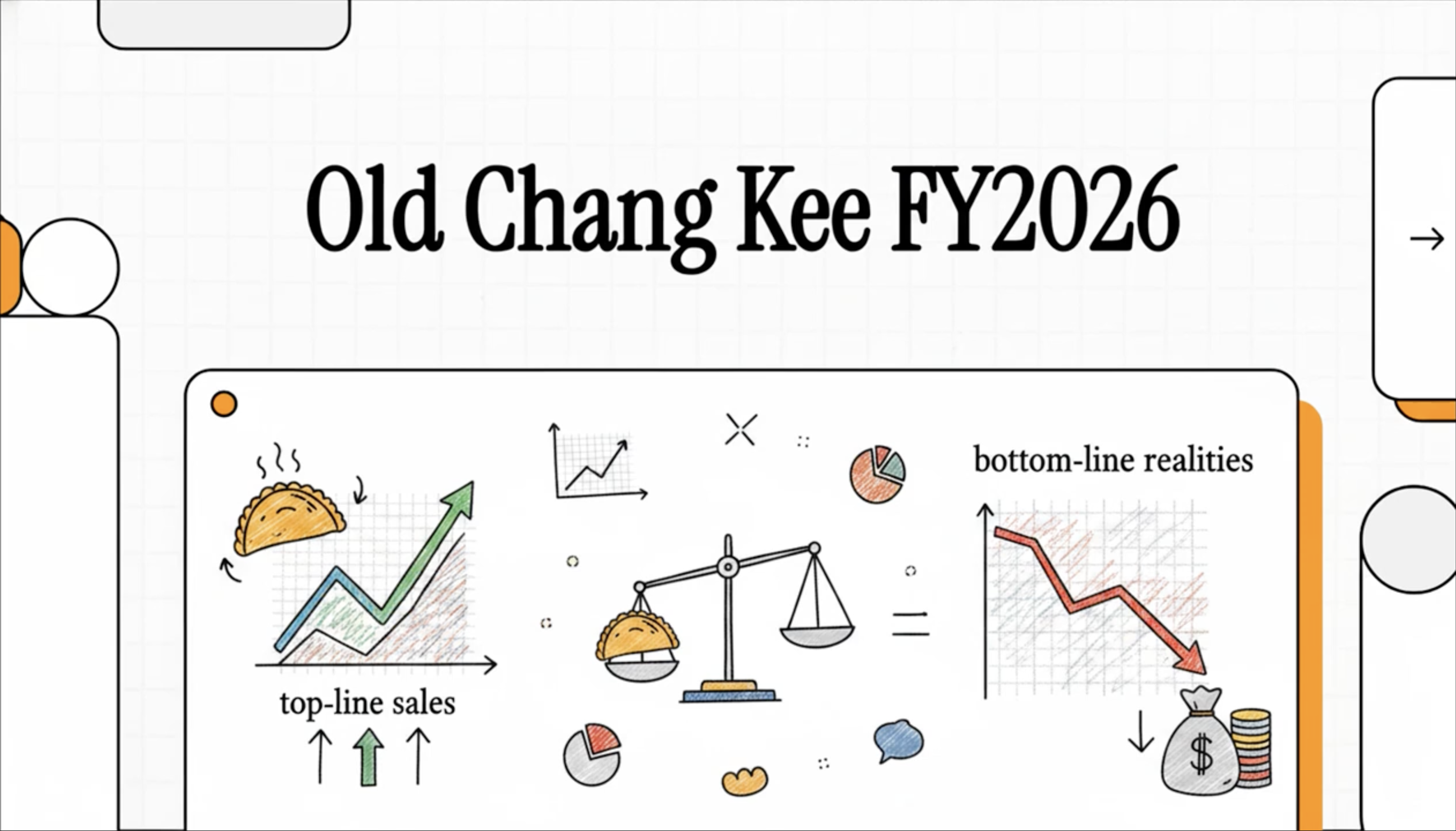
Old Chang Kee’s recently released FY2026 financial results (for the year ended 31 March 2026) reveal the friction between a legacy snack brand and a modern economic reality. The retail sector in Singapore is currently besieged by a “triple threat”: escalating raw material costs, high-traffic rental hikes, and a tightening labor market shaped by structural shifts. For Old Chang Kee, these pressures manifested in a 15.8% decline in profit after tax, which fell from S11.3 million to S9.6 million.
This creates a fascinating financial paradox. How did a company facing a double-digit decline in net profit and a 12.5% dip in profit before tax decide to reward its shareholders with a significantly higher dividend than the previous year? The answer lies in a combination of disciplined cash management and a quiet strategic pivot that every retail investor should be watching closely.
1. The Surprising Dividend Boost Despite Profit Headwinds
Under normal circumstances, a shrinking bottom line leads to a tightening of the purse strings. Old Chang Kee, however, has signaled immense confidence by doing the opposite. For FY2026, the Board recommended a final dividend package consisting of an ordinary final dividend of 1.0 Singapore cent and a “Special Final” dividend of 1.0 Singapore cent.
This effectively doubles the final period payout compared to the previous year. When totaled with the interim dividends, the full-year distribution reaches 3.0 cents per share (S3.64 million), a sharp rise from the S2.43 million distributed in FY2025. Even though Earnings Per Share dropped from 9.35 cents to 7.87 cents, the current 3.0-cent payout is still comfortably covered. This move suggests that management views the current profit dip as an operational hurdle rather than a threat to their core cash generation capabilities.
As the Group noted in its results commentary:
“While inflationary pressures, particularly rising raw material, labour, and prime location rental costs remain a concern, the Group is proactively navigating these headwinds.”
2. A Fortress Balance Sheet with a Growing Cash Pile
The ability to sustain higher dividends while profits contract is only possible because of what I would call a “fortress” balance sheet. As of 31 March 2026, the Group’s cash and bank balances climbed to S57.9 million, up from S52.4 million the year prior. In a high-interest-rate environment, where capital is expensive, having S$58 million in liquid ammunition is a massive competitive advantage.
Even more impressive is the Group’s debt profile. Bank loans repayable within one year were slashed to just S$336,000, while bank loans repayable after one year dropped to exactly zero. This lack of long-term debt isolates the company from credit market volatility. This “war chest” isn’t just for defense; the Group has explicitly signaled its intention to use this capital for “synergistic business combinations” and to scale its manufacturing and logistics capabilities. For a snack brand, the factory floor is just as critical as the storefront, and Old Chang Kee has the cash to make its production line even more efficient.
3. The Quiet Growth of Non-Retail Channels
While the kiosks at MRT stations remain the face of the business, the real growth story is happening in the “non-outlet” segment. Analysis of the Group’s revenue reveals that while retail outlet sales grew by a marginal 0.6% (reaching S90.6 million), non-retail sales—comprising delivery, catering, and B2B services—surged by 8.3% to S12.9 million.
This shift is a strategic necessity. Non-outlet sales now represent 12.4% of total revenue, up from 11.6% just a year ago. By leaning into corporate catering and delivery, Old Chang Kee is successfully bypassing the crushing overhead of “prime location” rentals and the persistent manpower shortages exacerbated by Singapore’s ageing demographics and the progressive wage model policy.
Furthermore, a keen eye on the administrative expenses reveals a modern cost of doing business: bank charges rose this year due to an increase in digital payment transactions. While these “merchant rates” clip the margin, they are the table stakes for a brand evolving alongside a digital-first consumer base.
4. Maintaining the 69% Margin Wall
In an era of food-cost inflation, maintaining a gross profit margin is an uphill battle. Yet, Old Chang Kee managed to hold its “margin wall” at a remarkably stable 69.2% for FY2026—matching its FY2025 performance.
This stability is counter-intuitive. With food costs and labor rising, the margin should have eroded. The company credited “gross margin optimisations,” cost reduction measures, and operational streamlining for this feat. Essentially, they are finding ways to produce the same curry puff more efficiently, allowing them to absorb rising input costs without sacrificing the core profitability of the product itself. It is a masterclass in retail operational discipline.
Key Financial Performance Visualized
The following table highlights the tension between rising revenue and cash reserves against the contraction in pre-tax profit.
| Metric | FY2025 (S$’000) | FY2026 (S$’000) | Change (%) |
| Revenue | 101,952 | 103,476 | +1.5% |
| Gross Profit | 70,588 | 71,588 | +1.4% |
| Profit Before Tax | 13,443 | 11,756 | -12.5% |
| Cash and Bank Balances | 52,438 | 57,916 | +10.4% |
Resilience in Every Bite
Old Chang Kee’s FY2026 performance is defined by a calculated trade-off. The company is allowing its net profit to absorb the “inflationary shocks” of the Singaporean market—namely labor constraints and rising supply costs—while simultaneously doubling down on shareholder returns and building a massive cash reserve.
With Net Asset Value increasing from S0.47 to S0.53 per share, the intrinsic value of the company is undeniably growing. The Group has zero long-term bank debt and nearly S$58 million in the bank, positioning it perfectly to acquire smaller competitors or expand its manufacturing footprint when the right opportunity arises. For the savvy investor, the question is now clearer: Given its aggressive dividend hike and ironclad balance sheet, is Old Chang Kee now more of a “value play” or a “defensive cash cow” for the years ahead?
Related stories: This Paved The Way For A 319% Profit Surge At JB Foods In FY2026