


Overview:
- Biomedical research in Singapore directly informs medical practice and shapes national health policy.
- Understanding the mechanisms of aging and translating these insights into clinical assessment and healthcare planning aims to identify early-life interventions that can alter long-term health and reduce chronic diseases.
- The team is also exploring strategies to curb rising healthcare costs by addressing major drivers such as diabetes and cardiovascular disease through earlier and more effective interventions.
- Their long-term goal is to narrow the 10-year health‑span gap, enabling Singaporeans to remain active contributors to society and enjoy a higher quality of life in older age.
A*STAR pushes early-health interventions to narrow Singapore’s 10‑year health‑span gap
Singapore is intensifying efforts to reshape its Singapore health policy framework by targeting earlier interventions for chronic diseases that drive long‑term care costs. New biomedical research insights are now being translated directly into clinical workflows and national planning to close the country’s 10‑year health‑span gap.
“Biomedical research, the way we are translating our research into the medical system, has impact on health policy,” Dr Ralph Graichen, Executive Director, Population Health at A*STAR told BackgroundBriefing.news. He noted that previous research outcomes have already been adopted by government agencies in shaping Singapore health policy priorities.
Early intervention as a cost‑containment lever
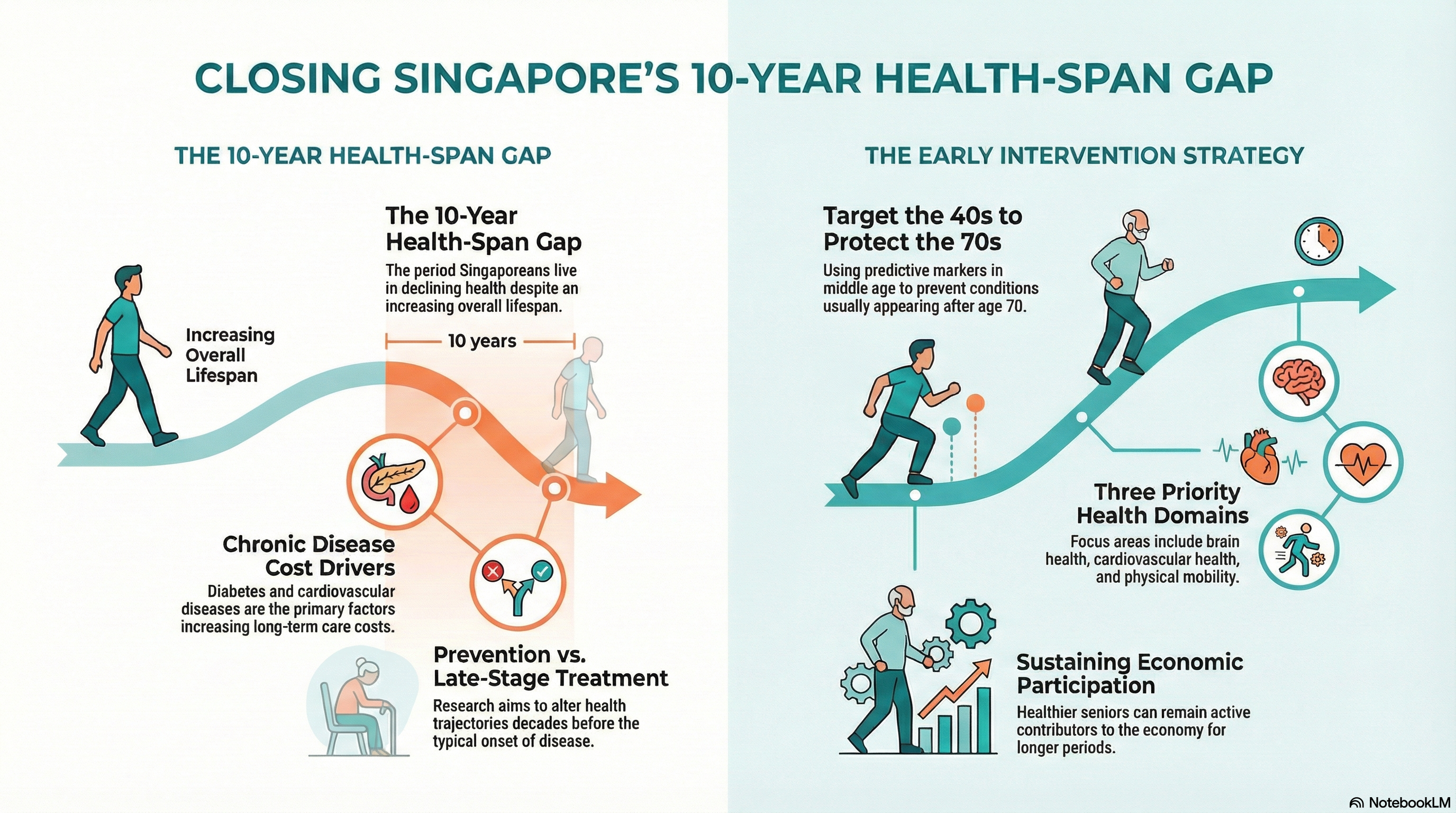
Chronic diseases—including diabetes and cardiovascular disease—remain among the biggest cost drivers for Singapore’s healthcare system. Dr Graichen said the research teams are examining how early medical and behavioural interventions can alter an individual’s health trajectory decades before disease onset.
“We are looking at how early we can actually intervene, when an intervention makes sense, and what the cost‑benefit of an earlier intervention would be,” he said. These findings were expected to inform updated Singapore health policy frameworks focused on prevention rather than late‑stage treatment.
The research programme is also studying predictive markers that could help physicians provide targeted advice to people in their 40s, potentially preventing the onset of conditions that typically appear after age 70.
Reducing the health‑span gap through targeted domains
A*STAR’s initiative is centred on shrinking the nation’s 10‑year health‑span gap, which represents the period in which Singaporeans live in declining health despite longer lifespans. Dr Graichen said the work focuses on three priority areas: brain health, cardiovascular health, and mobility—all of which directly influence independence and economic participation.
“We want to keep the whole population healthy and make the whole experience of life more enjoyable,” he said. The goal is not only better health outcomes but also allowing seniors to remain active contributors to the economy longer—another priority area flagged in ongoing Singapore health policy discussions.
More stories: Journalism faces AI disruption but experts say survival is certain
About the speaker:
Dr Ralph Graichen
Executive Director
A*STAR
Dr Ralph Graichen, Executive Director at A*STAR and Corporate Advisor at Temasek, has over two decades of leadership experience across biomedical, nutrition, and agri‑food innovation. He has worked in start‑ups, multinational companies, and public agencies, shaping R&D strategy and guiding deep‑tech investments.
His career spans roles in scientific research, product development, strategic partnerships, and national‑level innovation initiatives, contributing to Singapore’s food, health, and consumer‑care research landscape.
5W1H summary:
| What |
|
| How |
|
| Why |
|
| Who |
|
| Where |
|
| When |
|
FAQs:
What is the main focus of the research discussed in the interview?
The research focuses on understanding aging mechanisms and translating biomedical findings into practical medical and policy applications in Singapore.
How does the research contribute to Singapore’s healthcare policies?
Insights generated from past and current projects have been used by the Singapore government to shape and refine national health policies, especially around prevention and healthy aging.
Why is early intervention highlighted as a critical strategy?
Early intervention can alter long‑term health trajectories, reduce risks of chronic diseases such as diabetes and cardiovascular disease, and lower future healthcare costs.
Who stands to benefit from the outcomes of this research?
The entire Singapore population benefits through improved health‑span, better clinical assessment tools, and more effective preventive healthcare policies.
What challenges in healthcare costs are being addressed?
The research aims to tackle rising costs driven by chronic diseases by identifying when early interventions provide meaningful cost‑benefit advantages.
Which specific health areas are being targeted for improvement?
Key focus areas include brain health, cardiovascular health, and mobility—domains most responsible for the 10‑year health‑span gap in Singapore.
How will these efforts improve the lives of older adults?
By closing the health‑span gap, older adults can remain active, mobile, and engaged longer, improving both quality of life and economic participation.
Will the research ever be considered “complete”?
The work is ongoing, with the long‑term goal of reducing the health‑span gap and continuously informing evolving healthcare policies and practices.
Primary Source: Full Interview Transcript.
The time we are thinking is really how our research can impact the well-being and the medical situation in Singapore. Biomedical research, the way we are translating our research into the medical system, has also impact on health policy.
Part of what we have been doing in the past has actually been used by the Singapore government to implement health policy.
What are you proposing in order to increase a health-span as it were?
On a biomedical side, we are very interested in the mechanism of action for aging to really understand that. We are then looking how we can translate that into medical practice, which means how is your doctor looking at you? How is your doctor helping you in assessing your situation and then how to use that in terms of healthcare policies. Again, what we want to look at is how to keep the whole of the population healthy.
Clearly, you have a number of arrows in the quiver to shoot down some of the health inflation numbers. What specifically do you have at your disposal to try to bring that down?
Some of it is what is currently bringing up healthcare costs. A big driver in Singapore are diseases like diabetes and cardiovascular disease.
We are looking with some of the research we have done previously at how early we can actually intervene, when does an intervention make sense and what would be the cost benefit of an earlier intervention? Can we detect and actually change how the trajectory of an individual is going into the future? Can I provide advice to someone at 40 to bring them on a trajectory that prevents problems when he or she reaches 70 or 75?
Will your work ever be done? And if so, what outcomes are you looking for?
We are looking to close the gap, to decrease the 10-year health-span gap. This would make it possible for people to be active longer.
There would also be the benefit of being an active economic contributor to the nation. This allows people to be longer able to enjoy life or their golden ages.
We will look specifically in areas like brain health, cardiovascular health, and mobility. It is much more enjoyable to actually plan in the morning that I want to go out and enjoy meeting my friends in the park, I want to enjoy picking up my grandchildren rather than sitting at a table counting pills and trying to see how I can navigate my way to the kitchen.
We want to make that whole experience of life more enjoyable.