


Overview:
- Container shipping is pivoting towards becoming logistics giants, requiring a recalibration of capital structure.
- Investments in logistics are driving valuation uplift, reducing earnings volatility, and lowering market sensitivity.
- Diversification into logistics decreases reliance on freight rate fluctuations and improves financial stability.
- Companies hold excess liquidity and debt capacity, creating strong conditions for strategic investments.
- Capital structure must evolve to align with the new business model, ensuring optimal debt-equity mix and liquidity management.
Container shipping companies are racing to reinvent themselves as logistics giants, a shift that demands a radical overhaul of their capital structures to sustain growth and competitiveness. Valuation Gains Drive Strategic Investments
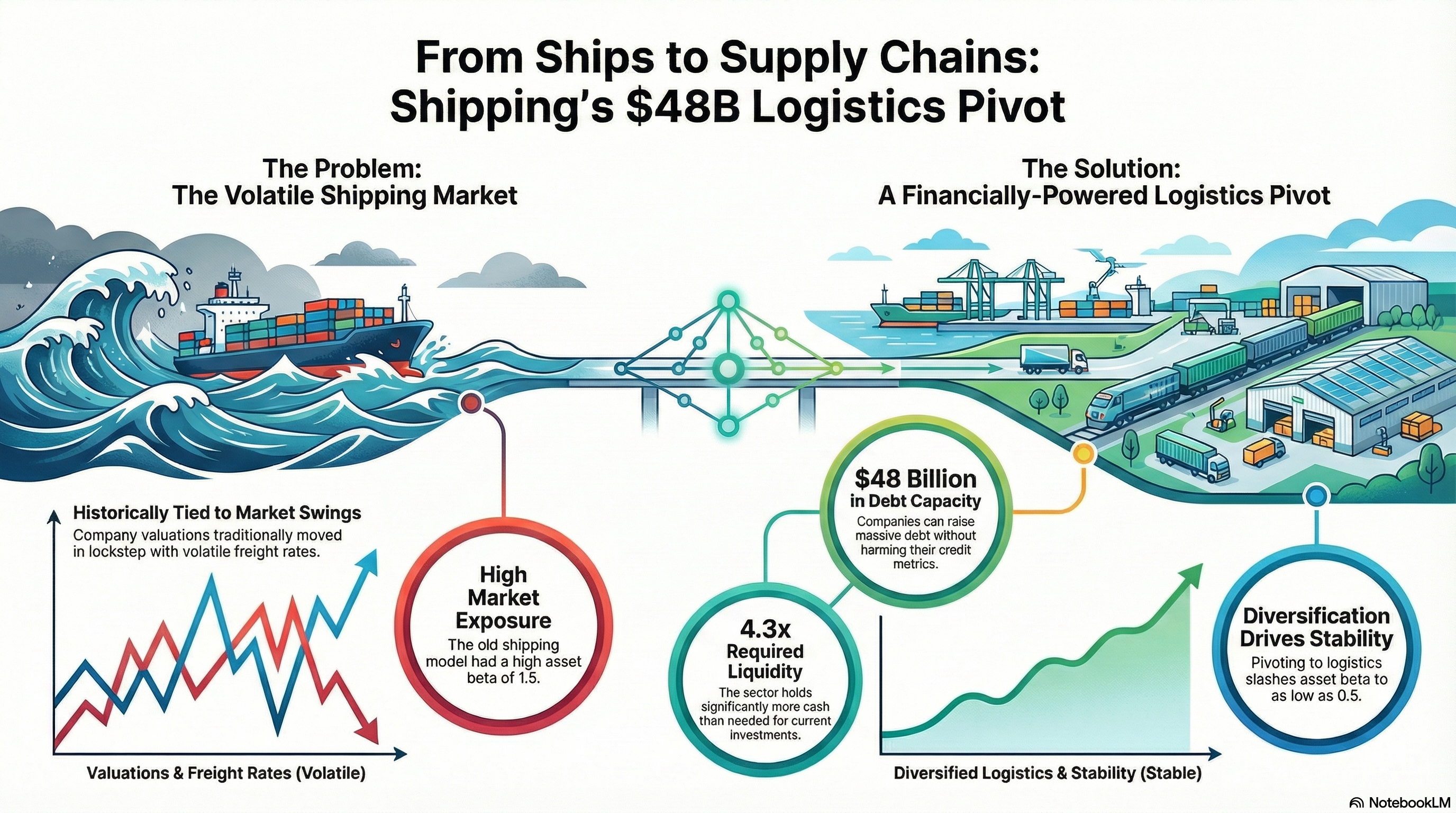
The sector is witnessing a surge in investments in logistics infrastructure, from container hubs to integrated supply chain services. Analysis by Standard Chartered shows companies investing heavily in logistics outperform peers on valuation multiples. “If you invest more into the logistics space as a container shipping business, you’re going to see valuation uplift, less volatility in your earnings and less sensitivity to the market environment,” said Dieu Anh Khuat, Executive Director at Standard Chartered.
Volatility and Sensitivity Decline
Historically, container shipping valuations moved in lockstep with freight rate volatility. Today, diversification into logistics has broken that link, reducing earnings swings and lowering asset beta from 1.5 to as low as 0.5. This means companies are less exposed to market shocks, a critical advantage in uncertain global trade conditions.
Liquidity and Debt Capacity Create Opportunity
The sector holds 4.3 times more liquidity than required for investment, compared to just 0.9 five years ago. Additionally, firms can raise up to $48 billion in debt without harming credit metrics. “There’s excess liquidity and capacity in terms of debt raising, and companies should be well positioned to invest,” noted Khuat.
Capital Structure Must Evolve
The challenge lies beyond funding. As business models shift, traditional capital structures no longer fit. Companies must recalibrate debt-to-equity ratios and liquidity buffers to align with logistics-driven strategies. Failure to adapt could undermine the benefits of diversification and valuation gains.
More stories: Standard Chartered tackles client lifecycle risk management to scale across 50+ markets
About the speaker:
Dieu Anh Khuat
Executive Director and Regional Lead for Capital Structure & Rating Advisory (CSRA), ASEAN & South Asia
Standard Chartered
Dieu Anh Khuat is Executive Director and Regional Lead for Capital Structure & Rating Advisory (CSRA), ASEAN & South Asia at Standard Chartered. She also heads advisory for Transport & Logistics and Commodity Traders & Agriculture sectors within CSRA, a team that provides thematic insights, rating advisory, and risk management strategies to corporate clients.
She joined Standard Chartered in 2021 after more than a decade at Citi, where she advised and structured debt financing for public sector and corporate clients across Europe and Asia. Anh holds a Master’s in Finance from London Business School and a Bachelor’s in Economics from the London School of Economics. [sc.com]
FAQs:
Why is container shipping pivoting towards logistics giants?
The sector is moving beyond traditional shipping to integrated logistics to diversify revenue streams and reduce dependency on volatile freight rates.
What does this shift mean for capital structure?
It requires recalibrating debt-to-equity ratios and liquidity strategies to align with a logistics-centric business model.
Why are the stars aligned for investment in this sector?
Valuation uplift, reduced earnings volatility, and lower market sensitivity make logistics investments highly attractive for container shipping companies.
How does diversification impact earnings volatility?
Companies investing in logistics have broken away from freight rate volatility, leading to more stable earnings over time.
What is the significance of asset beta in this context?
Asset beta measures sensitivity to market movements; shifting to logistics can reduce beta from around 1.5 to approximately 0.5, lowering risk exposure.
How much liquidity does the sector currently hold?
The sector holds about 4.3 times more liquidity than required for investment, up from roughly 0.9 five years ago.
What is the debt capacity available for companies?
Companies can raise up to US$48 billion in additional debt without negatively impacting their credit metrics.
Is investment alone enough to succeed in logistics?
No. Firms must also adapt their capital structure and financial strategy to support the evolving logistics-focused business model.
What role does Standard Chartered play in this transition?
The bank advises on capital structure and rating strategies, helping companies optimize funding mix, debt capacity, and liquidity buffers for future growth.
What is the ultimate benefit of getting capital structure right?
It ensures financial resilience, supports strategic investments, and maximizes valuation gains in a logistics-driven future.
5W1H summary:
| Category | Summary Points |
|---|---|
| What |
1. Container shipping pivots to logistics giants 2. Capital structure recalibration becomes essential 3. Investments drive valuation and stability |
| How |
1. Diversification reduces earnings volatility 2. Asset beta drops from 1.5 to 0.5 3. Liquidity and debt capacity enable funding |
| Why |
1. Improve valuation multiples significantly 2. Lower sensitivity to market shocks 3. Support evolving logistics business model |
| Who |
1. Container shipping companies in ASEAN 2. Standard Chartered advisory team 3. Investors in Singapore and Malaysia |
| Where |
1. Singapore as financial hub 2. ASEAN and South Asia markets 3. Global container shipping sector |
| When |
1. Current investment cycle ongoing 2. Post-pandemic logistics transformation 3. Five-year liquidity trend improvement |
Transcript of the interview:
The key message here is really container shipping is pivoting towards logistic giants and that necessitate a recalibration of their capital structure. Now I’d like to tell you two main things.
- The stars are aligned for investment in the sector and
- as these investment are happening business models are evolving. Therefore capital structure also need to follow.
Why do I think the stars are aligned within this investment theme? Three main words.
- valuation,
- volatility and
- sensitivity.
And let me unpack it for you. So there’s a flurry of investment into the logistic containers and ports in the whole container shipping sector.
And as Stach, we’ve run the analysis of what has been the impact of these investment into valuation. And we noticed a very strong correlation.
Companies that make more investment especially into this logistics space tend to outperform in terms of their valuation multiples. So that’s a valuation point.
Now the second point that I mentioned which is volatility. Interestingly if you look at the sector maybe 5 years or even 10 years ago the performance of share prices of valuation in the sector is usually in lock step with the freight rates volatility.
But because of these investment and diversification into logistic earning volatility have actually reduced significantly for the sector. And for those who’ve made more investment they managed to break away from this freight rate volatility.
Third thing I mentioned to you which is a sensitivity diversification comes with the benefit of the fact that the sector become less sensitive to external market environment. So in finance we have this concept of asset beta which is a measure of how sensitive your underlying company or asset is moving with the overall market.
If you have an asset beta of one that means you’re in line with the market. You are above one you are a bit more sensitive and you’re below one obviously you are less volatile and if we look at it traditional container shipping sector is one and a half which is really significantly higher than the market sensitivity but as they pivot towards the logistic that number can go down to 0.5 which is a different story.
So at the end I just want to reiterate the message if you invest more into the logistics space as a container shipping business you’re going to see valuation uplift less volatility in your earnings and less sensitivity to the market environment.
But obviously there is some work to do, right? You can’t just make these acquisitions and just coast along. So what is it that you that either you bring to this conversation or that the companies need to bring in order to make these changes?
You are absolutely right, Mark. Such fascinating environment that we are in because of the change from a container shipping business into a logistic giants.
Effectively, we’re talking about changing business model. The companies are no longer the same.
That means the capital structure that they have today that serves well for a container shipping company is no longer applicable for a logistic company and this is exactly where we can come in as standard charter especially for my line of work when it comes to capital structure and rating advisory we help company recalibrate that capital structure what is the right debt to equity mix what is the right funding mix how much liquidity one should hold. The answer to that question these questions are very different if you look at yourself as a logistic companies versus a container shipping companies.
And ultimately if you get this right what are the fruits of that that await at the end of that?
That’s a great question once again thank you so much. I think for any business regardless of which industry you are in you need the right financial strategy to support and elevate your business strategy.
If the stars are aligned and the thesis is about valuation about low volatility lower sensitivity is telling us is that you need to invest, you need to go into this space, you need to make sure that you have the right tools financially to support you to get there and get the best of the outcome.
Yes, you can say that you can invest today because that’s one thing we notice in the sector is there’s loads of capacity. Whether you’re talking about liquidity or debt capacity, let me just give you some numbers from a liquidity standpoint.
The sector today holds 4.3 times more liquidity than what they need in order to invest. That number is staggering.
Why? Would you hold four times plus more than what you actually need? And if you look at the same kind of caliber number five years back, the sector actually hold much less than what they should have.
That was 0.9. You have less than what you need what you need to sustain your business.
- liquidity.
- debt capacity. 48 US billion.
That’s the number of extra debt that these company can incur without affecting their credit metrics. They can still do fine if they were to raise that much money.
So there’s excess liquidity and capacity in terms of debt raising in the balance sheet and company should be in a well positioned to invest. But it’s not simple as that.
It’s not yes investment is great. Yes, I can make these investment it stop there. No, it’s not just about funding this investment.
Go back to my message at the beginning because you are doing all of this investment. Your business is changing. You need to make sure your capital structure is fit for the future.