

At a glance
AstraZeneca Malaysia leadership and teams
Government healthcare stakeholders Malaysia
Lung cancer patients Southeast Asia
Accelerate AI drug discovery timelines
Expand early lung cancer detection Malaysia
Improve survival outcomes through innovation
Since 2021 AI deployment Malaysia
Ambition 2030 strategic timeline globally
Current ongoing healthcare transformation period
Malaysia national healthcare system
Southeast Asia emerging healthcare markets
Global pharmaceutical innovation ecosystem
Reduce late-stage lung cancer Malaysia
Improve 18-month survival outcomes globally
Lower waiting time for treatments
Deploy AI chest X-ray screening Malaysia
Cut development timelines by 30 percent
Partner government healthcare ecosystem Malaysia
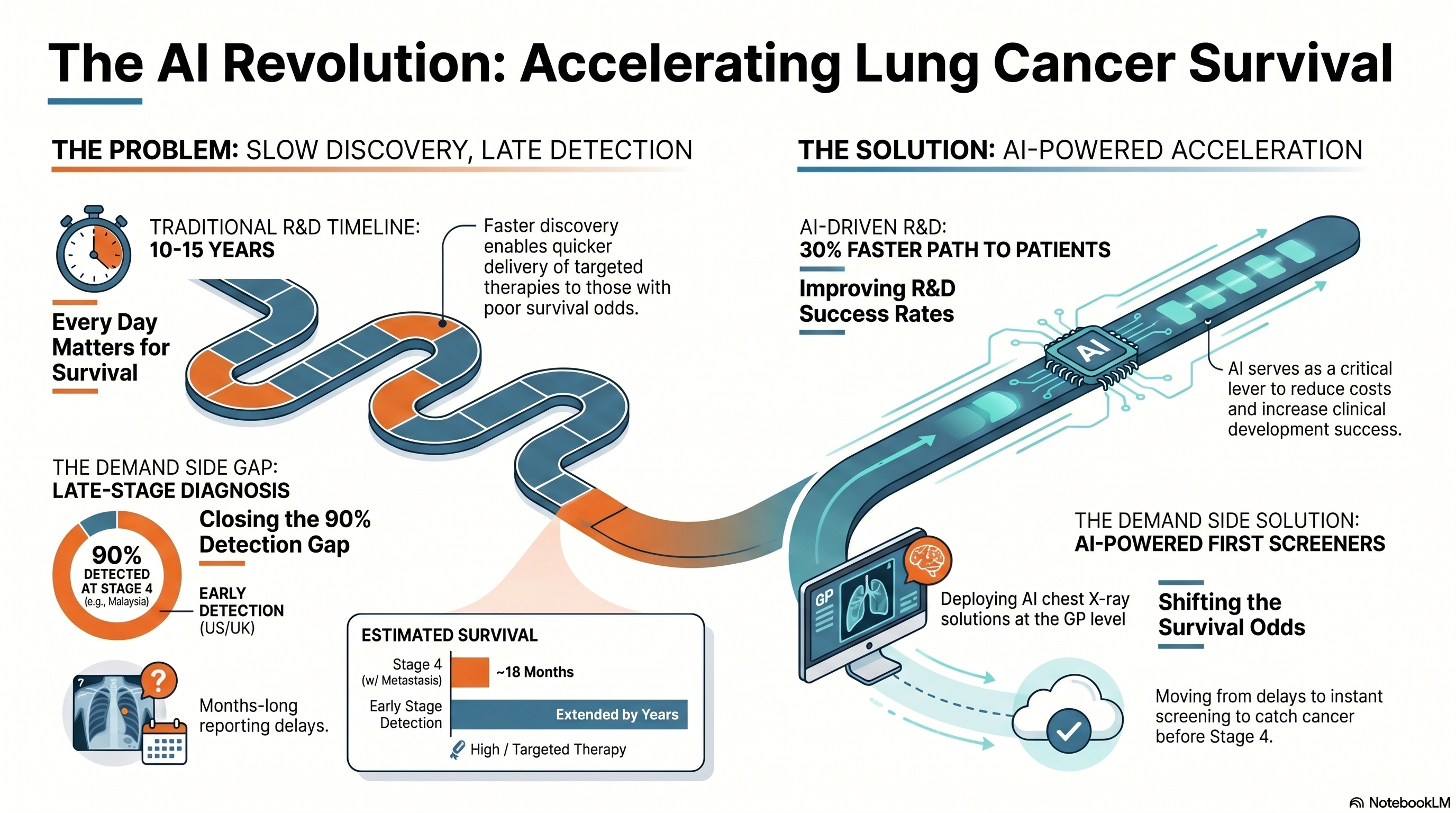
AstraZeneca is stepping up its investment in AI drug discovery to shorten treatment timelines and improve survival outcomes, as part of its Ambition 2030 strategy to deliver medicines to patients 30 per cent faster.
The pharmaceutical group is targeting a structural shift in how drugs are discovered and delivered, cutting the current industry timeline of 10 to 15 years by nearly a third. The move comes amid mounting pressure to address late-stage diagnoses in diseases such as lung cancer, where patients typically face poor survival odds.
“AI enables us to expedite discovery and development so that delivery to patients is faster, and that can mean everything to them,” said Dr Nur Syimah Izzah Abdullah Thani, Head of Corporate Affairs told BackgroundBriefing.news.
She added: “If you cut that short by 30 per cent, patients have a shorter waiting time. Every life and every day matters.”
The push reflects growing industry adoption of AI drug discovery, which is seen as a critical lever to improve success rates, reduce costs, and accelerate clinical development in an increasingly competitive landscape.
For patients with advanced lung cancer, the urgency is stark. A typical stage four patient diagnosed with lung cancer and brain metastasis has an estimated overall survival of about 18 months, according to AstraZeneca’s internal framing. Earlier diagnosis and faster access to targeted therapies could extend survival by years.
Why is AI critical to lung cancer outcomes?
The company is coupling its AI drug discovery investments with early detection initiatives, particularly in Malaysia, where diagnosis patterns remain skewed towards late-stage disease.
Currently, about 90 per cent of lung cancer cases in Malaysia are detected at stage four, largely due to limited diagnostic access and delays in reporting. This compares unfavourably with countries such as South Korea, the UK and the US, where earlier-stage detection is more common.
To address this, AstraZeneca has rolled out AI-powered chest X-ray solutions since 2021, partnering with healthcare providers to deploy them at the general practitioner level.
“In some settings, it can take months to get a report for a chest X-ray, and lung cancer can progress very fast from stage one to stage four,” Dr Nur Syimah said. “We use AI as a first potential screener to catch these patients early.”
The initiative aims to reduce reporting delays and enable faster clinical decision-making, effectively complementing advances in AI drug discovery with improvements in diagnosis and care pathways.
Can Malaysia shift to earlier-stage detection?
The broader goal is to shift the national “stage distribution” of lung cancer towards earlier diagnosis, where intervention is more effective and survival rates significantly improve.
AstraZeneca is working with government stakeholders and industry partners to build an ecosystem that integrates screening, diagnosis and treatment more efficiently. This includes policy engagement to support the adoption of AI tools and improve healthcare system capacity.
The strategy underscores a dual approach: accelerating AI drug discovery on the supply side, while strengthening early detection on the demand side.
For investors and healthcare stakeholders, the implications are significant. Faster drug development cycles could enhance returns on R&D investment, while earlier diagnosis could reduce long-term healthcare costs and improve workforce productivity.
Ultimately, the company is betting that convergence between AI-led discovery and AI-enabled diagnosis will reshape oncology outcomes across emerging markets.
More stories: BD tackles shortage in healthcare professionals with robot pharmacy technology
Transcript of the interview:
We have an ambition at AstraZeneca to deliver medications earlier to patients via our Ambition 2030 goal. We aim to develop and discover drugs earlier to ensure we can expedite delivery by 30 percent by 2030.
Imagine you are a doctor and a 40-year-old gentleman comes to you with lung cancer and brain metastasis. What do you guess his overall survival chance is?
Based on my own personal experience, I am guessing it is not very long.
That is potentially a stage four cancer patient. If you look into the overall survival, the patient can probably survive for about 18 months.
We want to utilize AI to deliver medications earlier because the longer we wait for new innovations and targeted therapies, the more time we lose for the patient. Our goal is to improve overall survival and give patients a better life where they see light at the end of the tunnel.
We want patients to have options for treatment rather than having a doctor say there are no options left. This is our role as an innovator company to explore and expedite the delivery of our medications.
I have only just started covering the pharmaceutical industry for my publication. Can you help me understand what the difference is between you and others?
We are an innovator company that explores and discovers new drugs. We are investing heavily in AI to ensure that we expedite the discovery and development of drugs so that delivery to patients is expedited.
Do you know what the average timeline is for drug discovery from discovery to delivery for the patients?
I heard last week in an interview that it takes ten years.
It is about 10 to 15 years. If you cut that short by 30 percent, the patients have a shorter waiting time, which means everything to them.
Every life and every day matters, and with new innovation therapies, we can improve overall survival from 18 months to many years. This matters for the patients, their families, and the country because they are contributing to the economy.
Where do you see all of this going in the next five years? Do you think AI will have completely changed the picture?
AI is already changing the landscape, particularly regarding our initiatives in lung cancer. We are leading the effort in Malaysia to shift the staging of lung cancer patients.
Currently, 90 percent of lung cancer patients in Malaysia are diagnosed at stage four because we lack the correct modalities to diagnose them early. We want to work with the government to shift this staging much earlier, similar to the trends in Korea, the United Kingdom, or the United States.
Patients have a better survival rate when they are diagnosed at an earlier stage. To achieve this, we have invested in AI chest X-ray technology since 2021.
We are the pioneer of AI chest X-ray in Malaysia and partner with various groups to deploy these solutions to general practitioners. We want to catch these patients early.
The estimated time for a patient to get a chest X-ray report follows a specific process.
- First step: The patient receives the chest X-ray.
- Second step: The reporting of the chest X-ray takes place.
In general settings where there are limitations in expertise, it can take months to get a report for a chest X-ray. Lung cancer can progress from stage one to stage four very fast, and you do not want to lose that momentum.
We use AI solutions for X-rays to be the first potential screener to diagnose lung cancer. We are helping the government shape the ecosystem and shift the screening paradigm in Malaysia.
We hope there will be a stage shift for lung cancer moving forward. This ensures that whatever treatment we bring provides a meaningful value to the patients.
Sources & citations
- Unlocking the future of drug discovery through advances in AI accessed 2026-06-16