


At a glance
1. AstraZeneca and Svetlana Yanchuk leadership
2. Patients and healthcare systems Malaysia ASEAN
3. IKM Cancer Institute and partners Malaysia
1. Transform cancer into chronic disease globally
2. Invest 25% revenue into R&D
3. Expand diagnostics and clinical trials Malaysia
1. Current ongoing strategy and investments 2026
2. Immediate expansion of trials Malaysia
3. Long term goal chronic cancer management
1. Malaysia clinical trials and diagnostics focus
2. ASEAN region healthcare improvement context
3. Global AstraZeneca research and trials network
1. Improve survival rates across ASEAN populations
2. Address late stage cancer detection Malaysia
3. Enable targeted therapies for genetic mutations
1. Use AI for faster drug discovery
2. Deploy early and precision diagnostics Malaysia
3. Run 40 plus clinical trials Malaysia
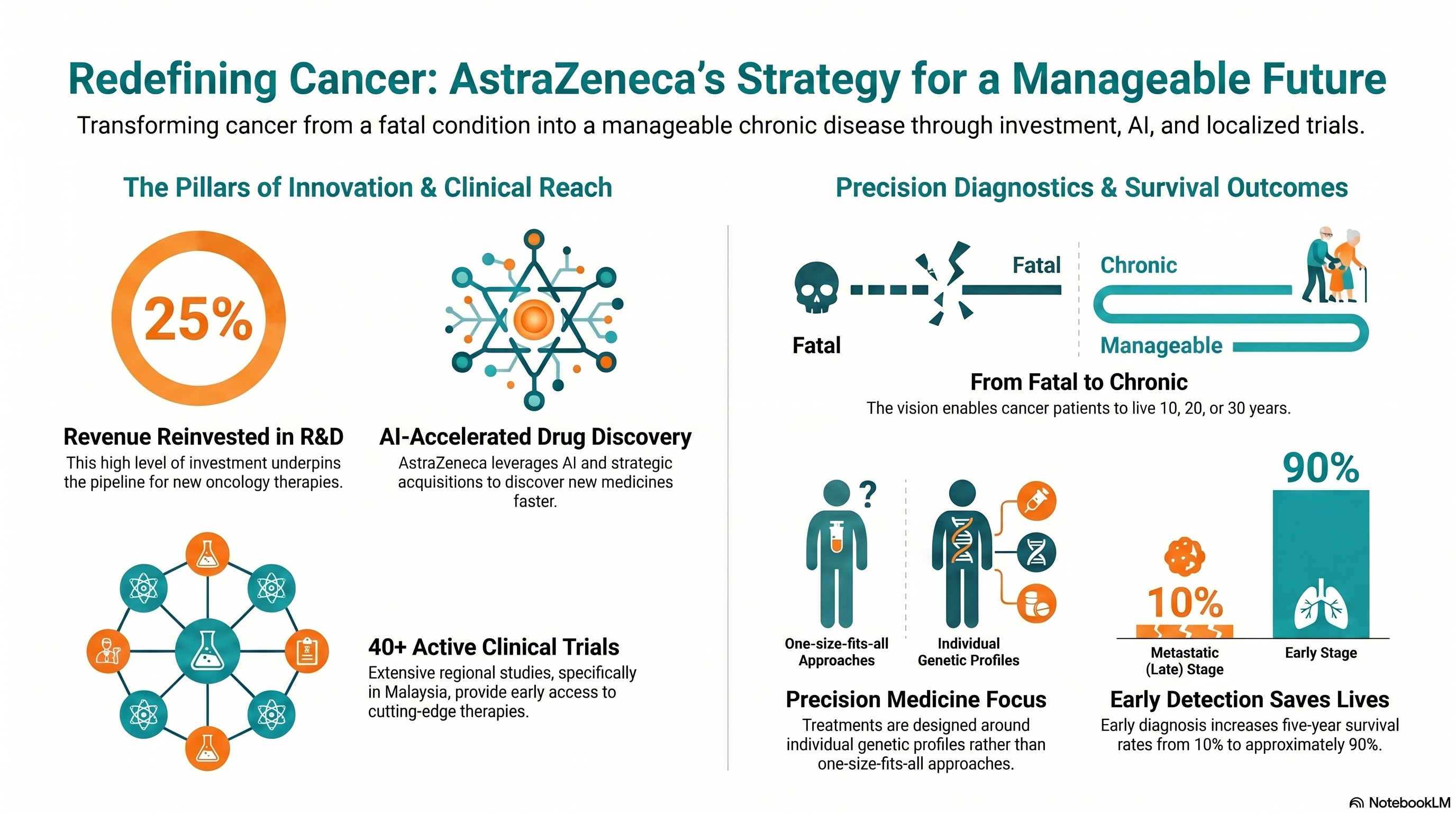
AstraZeneca is sharpening its long-term AstraZeneca cancer strategy with a combination of heavy research investment, expanded diagnostics capabilities and a growing footprint of clinical trials, as it seeks to redefine cancer from a fatal condition into a manageable chronic disease.
The pharmaceutical giant allocates roughly 25 per cent of its global revenue to research and development (R&D), a level of reinvestment that underpins its pipeline of oncology treatments and new therapies. This commitment is complemented by investments in artificial intelligence (AI) to accelerate drug discovery.
“Imagine if that is not the case anymore and cancer might be treated as a normal chronic disease. People with cancer can live 10, 20, or 30 years and still be with their families and children,” said Svetlana Yanchuk, Country President of AstraZeneca Malaysia told BackgroundBriefing.news.
The vision sits at the core of the company’s evolving AstraZeneca cancer strategy, which focuses on three key pillars: R&D, diagnostics, and global clinical trials.
How is AstraZeneca using investment to reshape cancer care?
AstraZeneca’s R&D spending—returning one-quarter of revenue into innovation—places it among a small group of multinational corporations with comparable reinvestment levels. The company is also leveraging AI through acquisitions aimed at discovering new medicines faster and more efficiently.
This focus reflects the industry-wide shift towards precision medicine, where therapies are increasingly designed around genetic profiles rather than one-size-fits-all treatments. The AstraZeneca cancer strategy emphasises identifying novel treatment pathways that can extend survival and improve quality of life.
Why are diagnostics central to AstraZeneca’s approach?
Beyond drug development, AstraZeneca is expanding its role in diagnostics through partnerships with laboratories and government-linked institutions. The company is focusing on both early detection and precision diagnostics.
Early diagnosis remains a critical challenge in Southeast Asia. In lung cancer—the leading cancer killer in Malaysia—only about 10 per cent of patients diagnosed at a metastatic stage survive five years. However, early-stage detection improves five-year survival rates to approximately 90 per cent.
“Early diagnosis is critical because patients diagnosed at earlier stages can survive much longer,” Yanchuk said.
Precision diagnostics, meanwhile, enables treatments targeted at specific genetic mutations or gene expressions, aligning therapy with the molecular profile of each patient. This reinforces the AstraZeneca cancer strategy by maximising treatment effectiveness while reducing unnecessary interventions.
What role do clinical trials play in Southeast Asia?
Clinical trials form the third pillar of AstraZeneca’s strategy, providing both access to cutting-edge therapies and data to support regulatory approvals. The company is currently running more than 40 clinical studies in Malaysia, making it one of the most active multinational sponsors in the country.
These trials are part of a broader global network designed to accelerate approvals and ensure new treatments reach patients faster. Malaysia, while relatively small, is increasingly positioned as a regional hub for clinical research.
The company is also collaborating with institutions such as the IKM Cancer Institute on lung screening initiatives, further strengthening its diagnostic ecosystem.
Taken together, these efforts position the AstraZeneca cancer strategy as a comprehensive approach that integrates therapeutic innovation, early detection and real-world clinical validation—key components in shifting cancer from an acute, life-threatening disease to a long-term manageable condition.
More stories: BD tackles shortage in healthcare professionals with robot pharmacy technology
Transcript of the interview:
Progress is absolutely fantastic. AstraZeneca is willing to transform care to the extent that we eliminate cancer as a cause of death.
It sounds fantastic, but in fact, it is already a reality. Imagine if you are diagnosed with cancer.
Well usually it is a death sentence isn’t it?
Absolutely, it is a verdict. Imagine if that is not the case anymore and cancer might be treated as a normal chronic disease.
People with cancer can live 10, 20, or 30 years and still be with their families and children. How does that sound?
Well, like I said, it is the holy grail. What are you doing about it to get to that point?
AstraZeneca is concentrating on three things.
- Research and development: We invest heavily in R&D, returning 25 percent of our revenue to this area.
- Diagnostics.
- Clinical trials globally.
One quarter of our revenue goes to research. Few multinational companies can say they are doing the same.
Okay. What do each of those mean?
Huge amounts of money are invested into research and development to look for something innovative. We recently acquired an AI company to discover new medicine faster.
When it comes to diagnostics, we are working in two aspects: early diagnostics and precision diagnostics. We are not a diagnostic company, but we produce and deliver medication.
Early diagnosis is critical because patients diagnosed at early stages can survive much longer. For example, lung cancer is the biggest killer in Malaysia.
Only 10 percent of patients diagnosed at a metastatic stage survive five years. If diagnosis happens earlier, 90 percent of patients can live five years or longer.
Precision diagnostics focuses on the fact that in the vast majority of cases, cancer is a genetic issue involving mutations or gene expression. If we can find the impacted gene, we can provide targeted treatment affecting that particular gene.
AstraZeneca also invests heavily in clinical trials across the globe. Malaysia is a relatively small country, but we are currently running more than 40 clinical studies here.
This is probably the largest number among multinational companies.
And what is it that AstraZeneca brings to this conversation that others can’t?
We are discovering and developing new innovative treatments to bring to the country. Diagnostics is another interesting topic where we are partnering with other laboratories and the government.
For example, we are running a diagnostic project together with the IKM Cancer Institute. This focuses on lung screening to diagnose lung cancer as early as possible.
Sources & citations
- Our Oncology R&D strategy: driving innovation and transforming patient outcomes accessed 2026-06-16