


At a glance
1. AstraZeneca Malaysia and Ministry of Health
2. Malaysian patients with chronic diseases
3. Healthcare professionals across Malaysia
1. AstraZeneca expands Malaysia disease screenings
2. US$20M Malaysia clinical hub investment
3. Focus on chronic kidney disease Malaysia
1. 2025 screenings and investment rollout
2. Expansion planned through 2030 Malaysia
3. Current urgent Malaysia health trends
1. Malaysia nationwide healthcare system
2. Central Malaysia and rural regions
3. Regional clinical hub serving ASEAN
1. Rising Malaysia diabetes and kidney cases
2. Healthcare costs reached RM4.4 billion Malaysia
3. Undiagnosed cases burden Malaysia healthcare system
1. Project Search nationwide screening Malaysia
2. 20,000 Malaysians screened in 2025
3. Ministry partnerships expand screening access
AstraZeneca is scaling up early screening and clinical research efforts in Malaysia as the country grapples with a growing burden of non-communicable diseases (NCDs), particularly diabetes and chronic kidney disease.
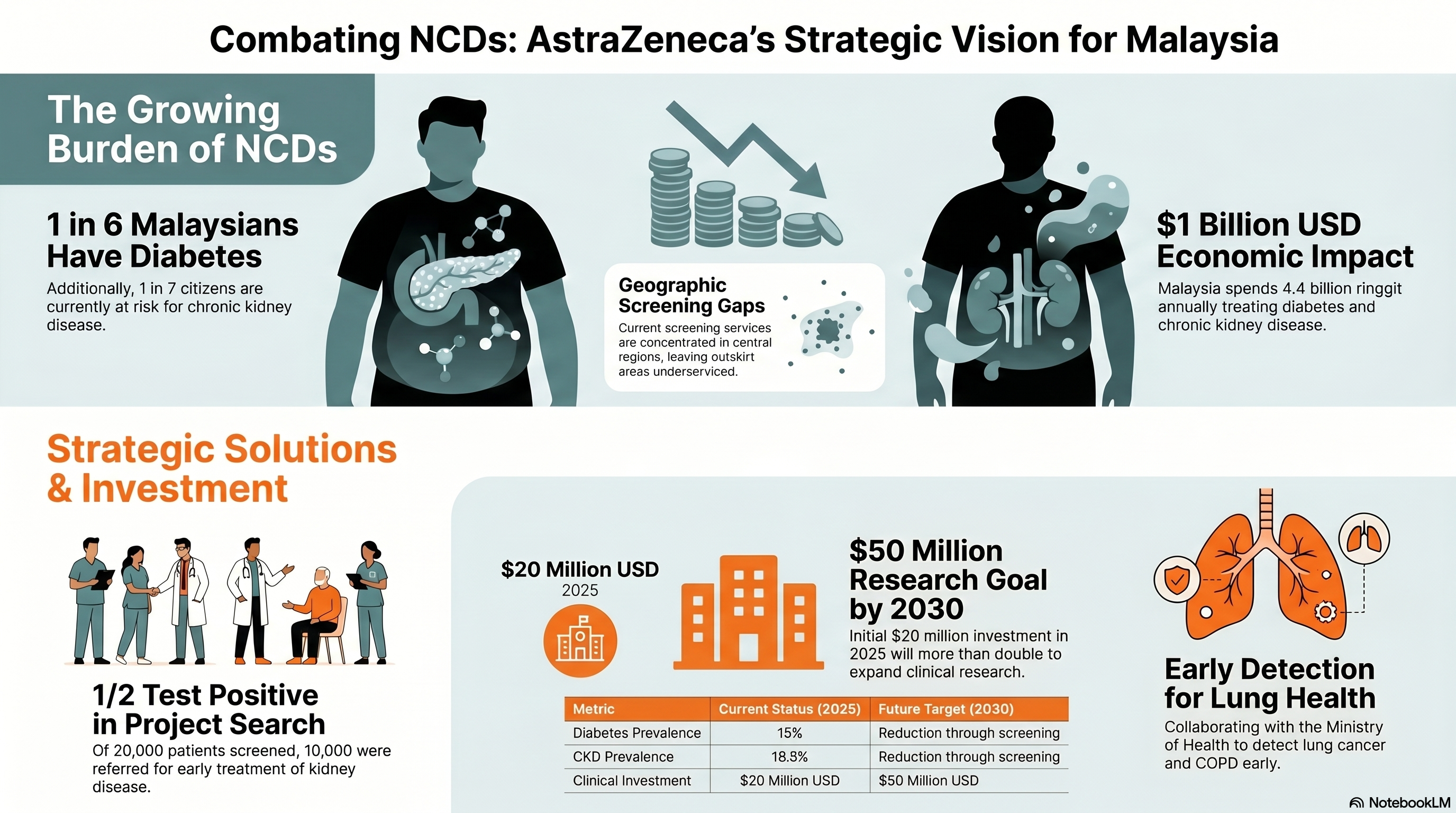
Recent estimates show that one-in-six Malaysians has diabetes, while one-in-seven is at risk of chronic kidney disease Malaysia, underscoring mounting pressure on both households and the national healthcare system. Government spending on managing these conditions has reached 4.4 billion ringgit (nearly US$1 billion), reflecting the rising economic toll.
Against this backdrop, AstraZeneca has deepened its collaboration with the Ministry of Health to prioritise early detection and intervention. “It is important for AstraZeneca, as an innovative pharmaceutical organization, to work together with the Ministry of Health to improve the health index,” said Jenny Poon, Business Unit Director, AstraZeneca Malaysia told BackgroundBriefing.news.
The company’s strategy centres on expanding screening access, strengthening diagnostics, and investing in research infrastructure to address chronic kidney disease Malaysia more proactively.
How effective are current screening programmes?
One of the cornerstone initiatives is Project Search, a nationwide screening programme aimed at identifying early-stage chronic kidney disease Malaysia. In 2025 alone, AstraZeneca screened 20,000 individuals, with nearly 10,000 referred to healthcare professionals for further evaluation.
Notably, one-third of those tested were found to be positive, highlighting a significant pool of undiagnosed cases. Early identification is critical, as patients diagnosed sooner are more likely to benefit from intervention before complications escalate.
Beyond renal care, AstraZeneca is also working on lung health initiatives focused on early detection of lung cancer and chronic obstructive pulmonary disease (COPD), aiming to improve patient outcomes through timely treatment.
What investments are being made to strengthen healthcare capacity?
To support long-term healthcare transformation, AstraZeneca has committed US$20 million (about RM100 million) in 2025 to establish a clinical hub in Malaysia. The facility is intended to serve as a regional centre for clinical research and innovation.
The company plans to expand its research investment further, targeting US$50 million by 2030. This move is expected to enhance Malaysia’s positioning as a regional hub for pharmaceutical innovation while supporting local healthcare delivery.
By integrating screening programmes with research capabilities, AstraZeneca aims to address both immediate diagnostic gaps and longer-term treatment development for chronic kidney disease Malaysia.
What gaps remain in access to healthcare?
Despite these efforts, access to screening remains uneven. Current programmes are largely concentrated in central regions, leaving rural and outskirt communities underserved.
AstraZeneca has identified this disparity as a priority area moving forward, with plans to extend screening accessibility nationwide. Improving geographic coverage is seen as essential to reducing overall disease prevalence and ensuring equitable healthcare outcomes.
The company is also tracking national health indices, which currently stand at approximately 15 per cent for diabetes and 16.5 per cent for chronic kidney disease Malaysia. While these figures highlight the scale of the challenge, they also provide a measurable baseline for progress.
With healthcare systems under strain from rising NCDs, AstraZeneca’s approach reflects a broader shift towards prevention, early diagnosis, and data-driven intervention as key levers for improving public health outcomes in Malaysia.
More stories: BD tackles shortage in healthcare professionals with robot pharmacy technology
About the speaker:
Jenny Poon
Business Unit Director
AstraZeneca Malaysia
Jenny Poon is a commercial leader at AstraZeneca Malaysia with over fifteen years of experience in the pharmaceutical industry. Currently serving as Business Unit Director, she manages strategic portfolios including cardiovascular, renal, metabolism, and respiratory health. Her recent work includes overseeing the commercial launch of triple-therapy treatments for chronic obstructive pulmonary disease.
Her expertise spans market access and business development within the Southeast Asian healthcare sector. She previously held marketing management roles at AstraZeneca, focusing on clinical research and development initiatives.
Transcript of the interview:
The prevalence of non-communicable diseases in Malaysia is on the rise, especially for diabetes and chronic kidney disease. One in six people have diabetes and one in seven Malaysians are at risk of chronic kidney disease.
Both diabetes and chronic kidney disease bring a significant burden not just to family members and carers, but also to the social economy. Malaysia has spent close to 4.4 billion ringgit, equivalent to almost 1 billion US dollars, on both conditions.
It is important for AstraZeneca, as an innovative pharmaceutical organization, to work together with the Ministry of Health to improve the health index. We do this through various initiatives.
- Lung health initiatives: We work with the Ministry of Health to detect lung cancer and COPD early so that patients get a better prognosis post-treatment.
- Project Search: We conduct widespread screening for early detection of chronic kidney disease.
In 2025, AstraZeneca screened 20,000 patients, and almost 10,000 were referred to healthcare professionals. We found that one-third of the patients tested positive, which is very alarming, and they will be treated as early as possible.
- Transforming care in Malaysia: We are building a clinical hub in Malaysia to serve the entire region.
AstraZeneca invested 20 million US dollars, which is close to 100 million ringgit, in 2025. We are aiming to expand the research, which will likely cost 50 million US dollars by 2030.
By investing in early screening and providing more clinical research for innovative medicine, our aim is to reach a better health index and better healthcare for Malaysians.
What does AstraZeneca bring to these conversations that others couldn’t?
AstraZeneca needs to build a wider partnership with the Ministry to ensure screening can be made more accessible to more people. Currently, screening is very much located only in the central region.
It is critical to address the outskirt areas. That will be an area we want to look at moving forward.
What sort of measurability do you have on being able to curb some of these non-communicable diseases?
We have statistical records in the Ministry of Health showing the index is around 15 percent for diabetes and 16.5 percent for chronic kidney disease. Our aim is to reduce this as much as possible through the screenings I mentioned.
This includes lung health screening for lung cancer and Project Search for chronic kidney disease. Hopefully, these projects can help us reduce the prevalence of chronic kidney disease in Malaysia.
Sources & citations
- Transforming kidney health and the burden of CKD accessed 2026-06-16