
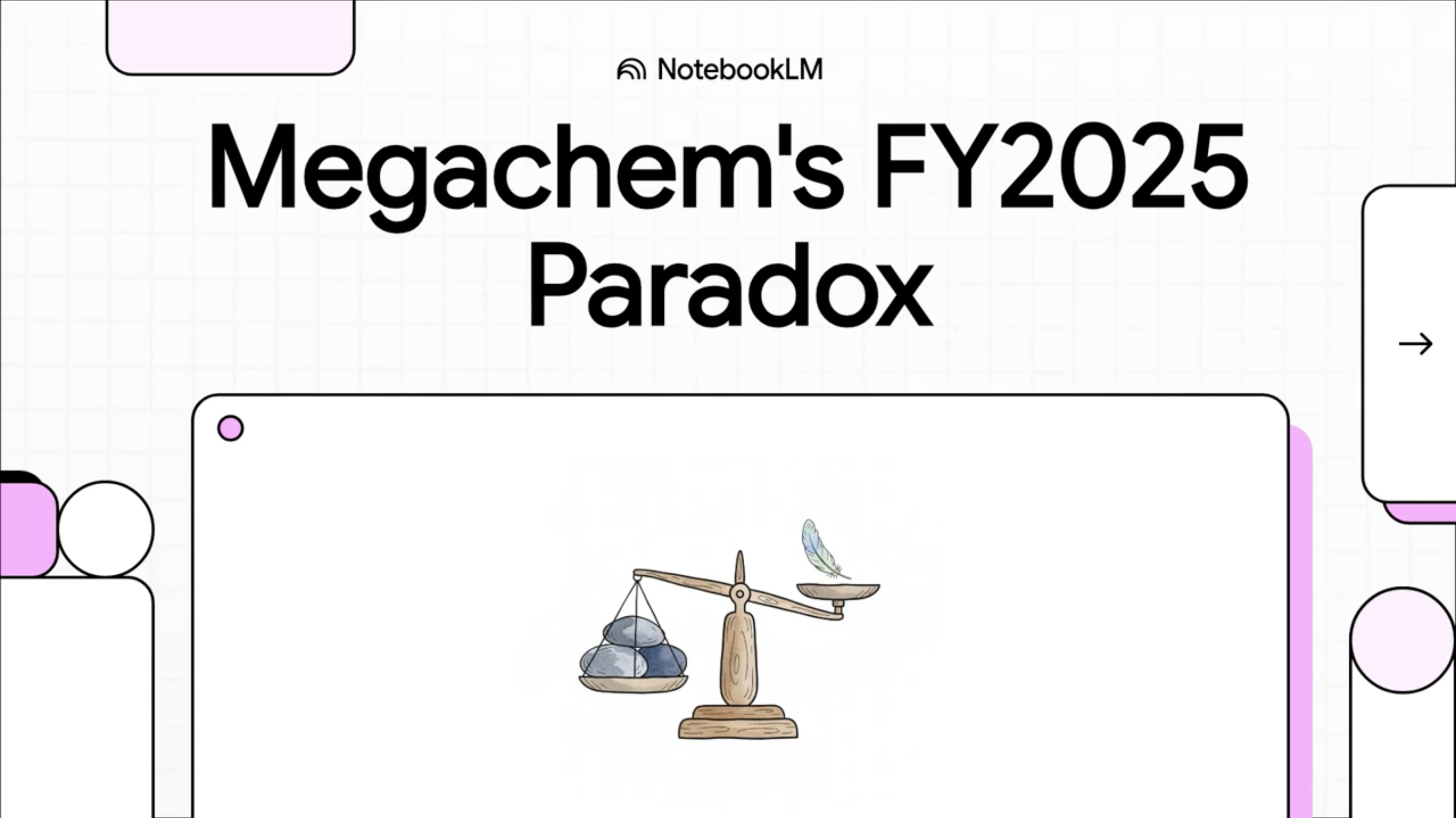

From Ashes to Assets
On July 5, 2023, a massive fire at Megachem’s facilities served as a literal and metaphorical trial by fire. For a global specialty chemical distributor—the invisible skeleton of the pharmaceutical and electronics sectors—such a catastrophe usually dictates a permanent retreat. Instead, the FY2025 results reveal a company pivoting from survival to a calculated, aggressive expansion.
The narrative has moved beyond disaster recovery. As Megachem navigates a global landscape defined by oversupply and cooling demand, it faces a fundamental strategic question: How does a business maintain its footing when its physical infrastructure and the global economy are both, effectively, under fire?
The 31% Growth Illusion (and Why It Matters)
The headline numbers suggest a retreat, with reported net profit after tax dropping 50.6% to S3.9 million. However, in the world of corporate finance, the headline is often a mirage. To find the “real” Megachem, one must look at the collapse of “Other Income,” which cratered from S10.7 million in FY2024 to just S$529,000 in FY2025.
The previous year’s profit was artificially inflated by S9.67 million in insurance compensation following the 2023 fire; this year, insurance claims fell to a negligible S22,058. When you strip away these one-off insurance life rafts and the absence of the S$3.8 million in decontamination costs that burdened the prior year, the core business health is revealed: an adjusted net profit increase of 31.1%.
“FY2025 was a challenging year for the chemicals industry amid ongoing global economic and geopolitical uncertainties… Despite this, our business has remained resilient, which is testament to our proven business model, extensive global networks and large customer base,” noted Mr. Sidney Chew, Managing Director.
The North Asia Surge: A Geographic Plot Twist
While consolidated revenue dipped 3.4% to S$124.4 million, the geographic data suggests that Megachem’s diversified network is acting as a vital shock absorber. The Group’s “Asia-centric” strategy allowed it to offset stagnation in mature markets with aggressive regional gains.
- Regional Retreats: Revenue in ASEAN, the Group’s largest market, fell 8.3% to S68.1 million. Similarly, the European market remained stagnant, declining 1.1% to S16.1 million.
- The Growth Engine: North Asia surged with a 27.5% increase in revenue, complemented by a 5.3% rise in the Middle East.
This geographic pivot validates the importance of a global footprint. By leaning into North Asian demand, Megachem successfully hedged against the “softer demand” and oversupply plaguing its traditional ASEAN strongholds.
Building for a Future of Oversupply
The most contrarian move in Megachem’s playbook is the S$18 million warehouse reconstruction at Pioneer Road. In a market currently suffering from an oversupply of chemicals, Megachem is choosing to expand its capacity by 60–80%.
This is a high-stakes bet on future consolidation. To fund this infrastructure, the company allowed its net gearing ratio to more than double—rising from 0.16 to 0.34 in a single year. By increasing its debt-to-equity to build massive, high-safety capacity, Megachem is gambling that it can lower third-party storage costs and crush competitors by becoming an indispensable “one-stop” titan by March 2026.
“This new warehouse supports our strategy of positioning ourselves as a one-stop solutions provider… allowing us to serve the diverse needs of our customers more effectively.”
The AI Bubble and Other Unlikely Villains
The outlook for FY2026 includes the typical headwinds of trade tensions and inflation, but Megachem has identified a more modern risk: “fears of an AI bubble.”
While this may seem like a Silicon Valley concern, Megachem is the literal feedstock for the hardware supporting the AI hype cycle. The Group serves the electronics and polymer industries—sectors that provide the raw materials for high-end components and infrastructure. If the AI sector experiences a sharp correction, the ripple effects will hit the chemical supply chains first, turning the industry’s current modest growth into a potential freeze.
Conclusion: The Long Game
Megachem ends FY2025 in a position of disciplined aggression. While debt has increased to 0.34 times gearing, it remains within a healthy range for a capital-intensive rebuild. Shareholders are set to receive a total dividend of 1.0 cent per share, yet the most telling figure is the Net Asset Value (NAV), which rose to 46.0 cents.
This NAV sits significantly higher than the dividend payout, signaling that management is focused on rebuilding intrinsic value and structural capacity rather than just returning cash during a recovery phase.
The ultimate question for the observer remains: In an uncertain world, is it wiser to hoard cash and exercise caution, or to leverage the balance sheet for an S$18 million infrastructure bet on a recovery that has not yet fully arrived?
Related stories: Why OTS Holdings Is Betting Big Despite A Swing To The Red In 1H 2026