

Overview:
- Gurin Energy is addressing Japan’s blackout risk by developing a 2 gigawatt hour battery energy storage project to unlock grid potential and enhance resilience.
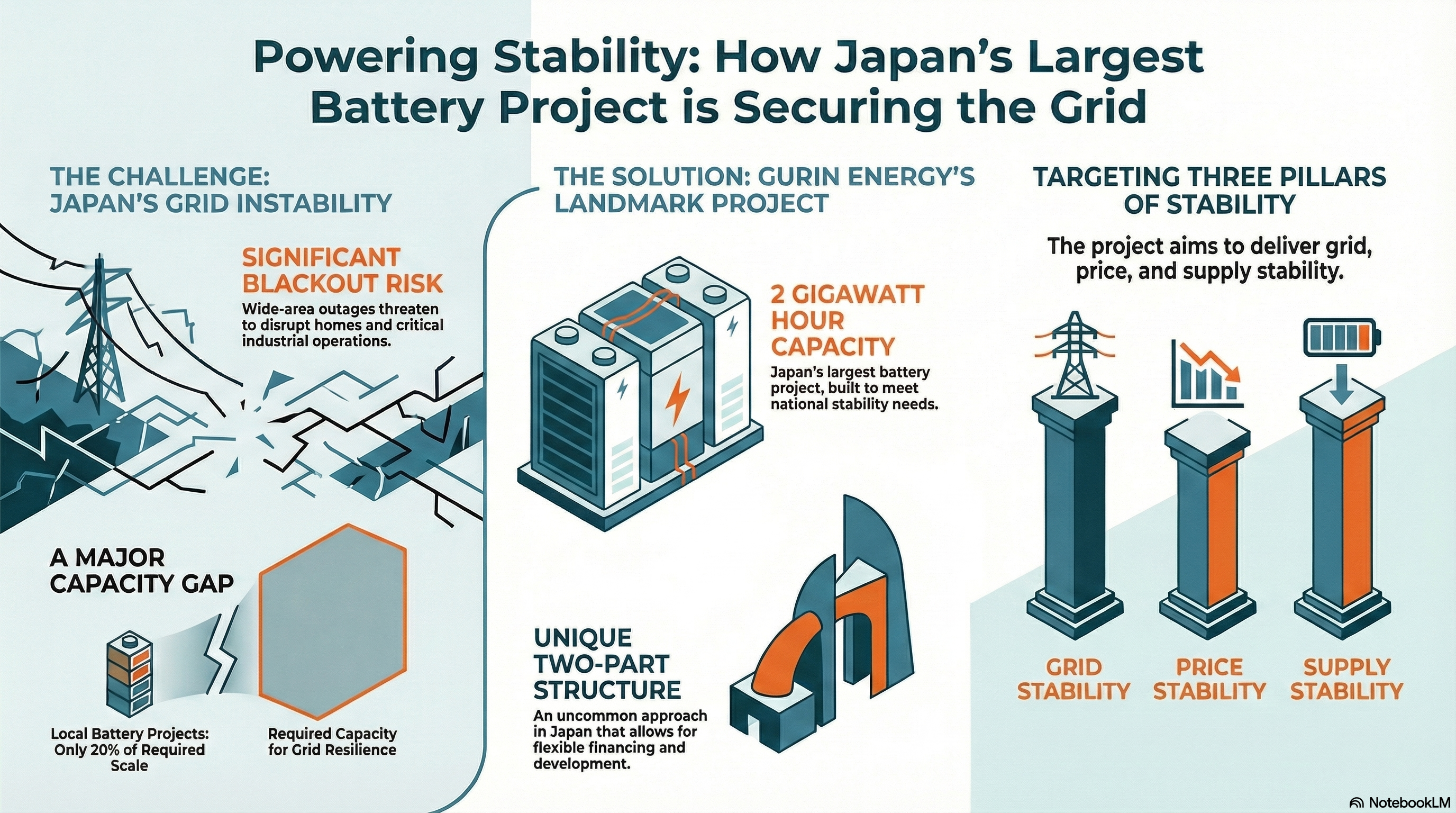
- The project’s scale is the largest of its kind in Japan and its two-part structure is uncommon locally, with typical projects reaching only about 20% of Gurin’s development size.
- Project development is advanced for Part A in Soma, Japan, where grid access and land have already been secured.
- Talent development has accelerated with a fivefold increase in local staff over two years and the launch of a community scholarship programme.
- Backed by deep regional expertise, Gurin’s goal is stability—grid, price, and supply—while exploring revenue streams to fully develop the project and enable future expansion.
Gurin Energy is advancing Part A of a 2GWh battery energy storage project in Soma, Japan, a two-phase build that the company says is currently the country’s largest and designed to strengthen Japan grid stability, smooth consumer prices and improve industrial supply reliability. The developer has secured grid access and land for the first phase and is exploring multiple revenue streams to fully finance the project and enable future expansion, positioning the asset to respond to demand spikes and mitigate wide-area outage risks described in the interview.
Project scope and structure
The company plans to execute the development in two parts—an approach it describes as unusual in Japan—while maintaining aggregate capacity at 2GWh to address Japan grid stability and resilience needs. “Scale is a key factor as our 2 gigawatt hour project is currently the largest in the country,” Sean Tan, SVP, Head of Treasury & Risk Management, told BackgroundBriefing.news. “We are splitting the project into two parts which is virtually unheard of in Japan.” According to the interview, most comparable projects in the market are significantly smaller, typically reaching only about 20% of Gurīn’s development size, underscoring the capacity gap the Soma installation is intended to fill.
Local execution and talent pipeline
Gurin has quintupled its local headcount in Japan over the past two years and launched a community scholarship programme, steps the company says are essential for project delivery discipline, permitting follow-through and stakeholder engagement. The person leading the Japan battery development brings 25 years of renewable energy experience and 10 years in regional battery energy storage, adding domain depth as the company pursues Japan grid stability outcomes. Tan said the team’s on-the-ground capability and senior oversight are fundamental to managing multi-year risk, interface with transmission operators and procurement cycles for critical components.
Commercial model and revenue streams
With grid interconnection and land secured for Part A, Gurin is evaluating revenue pathways to underwrite and optimise the asset, including potential multi-service participation that could anchor cash flows and support future expansion beyond the initial 2GWh. The company indicated that commercial design will be shaped to reinforce Japan grid stability while creating price signals that reduce volatility for consumers. “Revenue streams are being explored to fully develop our battery energy storage project and allow for potential future expansion,” Tan said, noting that the split-phase approach provides flexibility in financing and staged commissioning.
Stability outcomes targeted
The project’s stated objectives centre on three forms of stability: grid stability to strengthen infrastructure performance, price stability to moderate consumer electricity costs, and supply stability to support industrial operations. In the interview, the wide-area blackout scenario—hot bath turning cold, appliances shutting off, neighbourhoods going dark—served as a concrete illustration of the risk the asset is designed to address through storage-enabled load balancing and contingency support. “Grid stability aims to increase the stability of the grid infrastructure,” Tan said. The firm’s thesis is that large-scale storage, built at 2GWh and delivered in two parts, can contribute materially to Japan grid stability while complementing existing generation and transmission investments.
More stories: BNM fast-tracks digital asset innovation hub to shield retiree funds
About the speaker:
Sean Tan
SVP, Head of Treasury & Risk Management
Gurin Energy
Sean Tan, SVP, Head of Treasury & Risk Management at Gurin Energy, leads funding, risk and insurance and has steered corporate finance across the region. A former DBS Bank corporate banker and treasury specialist, he brings seven years of capital, issuance and balance sheet experience to renewables. At Gurin Energy, he previously served as VP, Corporate Finance, covering investments and project finance, including Thailand. Based in Singapore, he is a Certified Treasury Professional with a data-driven approach and hands-on execution across debt markets. Tan’s remit centers on building resilient financing, disciplined risk frameworks and bankable structures for large-scale energy storage.
Prior to renewables, Tan held progressively senior treasury roles at DBS Bank, leading wholesale debt issuance and investor relations, serving as subject-matter expert on covered bonds, and contributing to industry committees in Singapore and Europe; notable executions included SGD1 billion Additional Tier 1, AUD900 million floating-rate covered bonds, and USD750 million AT1. He managed capital planning, balance sheet and ALM across multiple markets, and built procurement and shipping expertise at Orica. Educated at the National University of Singapore, Tan is known for structured finance depth, cross-border project finance, and pragmatic risk management supporting Gurīn Energy’s battery and grid-scale ambitions.
FAQs:
What problem is Gurīn Energy’s Japan project trying to solve?
The project is designed to reduce the risk of wide-scale blackouts by strengthening grid resilience through large-scale battery energy storage, as illustrated by the interview’s blackout scenario.
How large is the battery energy storage system and how does it compare to others in Japan?
It totals 2 gigawatt hours (GWh), which the company says is currently the largest of its kind in Japan, while most other projects are significantly smaller—typically around 20% of this development size.
Why is the project split into two parts?
Gurīn is executing the build in two parts—an approach described as virtually unheard of in Japan—to deliver a large asset in stages, reflecting market context where comparable projects are smaller.
Where is Part A located and what milestones have been secured?
Part A is in Soma, Japan, with grid access and land already secured, indicating advanced development progress for the first phase of the 2GWh project.
What are the primary outcomes the project aims to deliver?
The project targets three forms of stability: grid stability to strengthen infrastructure, price stability for consumers, and supply stability for industry.
How does Gurīn plan to fund and scale the project?
The company is exploring revenue streams to fully develop the battery energy storage asset and create options for potential future expansion beyond the initial build.
What differentiates Gurīn from other players in Japan’s storage market?
Gurīn brings scale with a 2GWh installation and an uncommon two-part structure, supported by a local team and senior management with over 20 years in Asian renewables.
Who leads the Japan battery project and what is their experience?
The project lead has over 25 years of renewable energy experience and 10 years in regional battery energy storage, providing deep domain expertise for delivery and operations.
How will consumers and industries benefit from the project?
Consumers may see more stable electricity pricing, while industries gain stronger supply stability, both enabled by storage-based balancing and grid support.
5W1H summary:
| What |
1. 2GWh battery energy storage in Japan. 2. Split into two development phases. 3. Targets blackout risk and grid resilience. |
| How |
1. Secured grid access and land, Soma. 2. Split build allows staged financing, commissioning. 3. Quintupling Japan staff, community scholarships. |
| Why |
1. Increase grid stability across Japan. 2. Stabilise electricity prices for consumers. 3. Improve supply reliability for industry. |
| Who |
1. Gurīn Energy development and operations team. 2. Senior management, 20+ years Asian renewables. 3. Japan project lead: 25y renewables, 10y storage. |
| Where |
1. Soma, Japan, grid access secured. 2. Local operations across Japan communities. 3. Expertise drawn from Asian renewable markets. |
| When |
1. Part A development currently advanced. 2. Japan staff quintupled over two years. 3. Revenue exploration underway for expansion. |
Transcript of the interview:
Gurin Energy is attempting to unlock Japan’s grid potential with a 2 gigawatt hour battery project. It is currently the largest of its kind in Japan.
Imagine you are at home having a hot bath after a long day at work and suddenly the lights go out. It is pitch dark and the water suddenly turns cold.
You realise your fridge is not working and your washing machine has gone off. You look out the window and realise the entire area has gone dark.
This wide-scale blackout in downtown Japan is the problem we are trying to ensure does not happen. We are trying to achieve this through three focus areas.
- Project development is advanced on part A of our 2 gigawatt hour project in Soma, Japan, where we have secured grid access and land.
- Talent development includes quintupling our local staff in Japan over the last two years and establishing a community scholarship programme.
- Revenue streams are being explored to fully develop our battery energy storage project and allow for potential future expansion.
What does Gurin bring to this conversation that others in this industry are not?
There are two main things that we bring to the table.
- Scale is a key factor as our 2 gigawatt hour project is currently the largest in the country.
We are splitting the project into two parts which is virtually unheard of in Japan. Most other projects are significantly smaller and typically reach only about 20% of our development size.
- Expertise is provided by our local team and a senior management team with over 20 years of experience in Asian renewable energy. The person in charge of our battery project in Japan has over 25 years of experience in renewables and 10 years in battery energy storage in the region.
He is imminently capable and brings a significant depth of expertise to the table.
What is the goal and the vision for this project?
For Japan and this project in particular, we have three main outcomes we hope to achieve which are all related to stability.
- Grid stability aims to increase the stability of the grid infrastructure.
- Price stability aims to increase the stability of electricity pricing for consumers.
- Supply stability aims to increase the supply stability for industry.