

Overview:
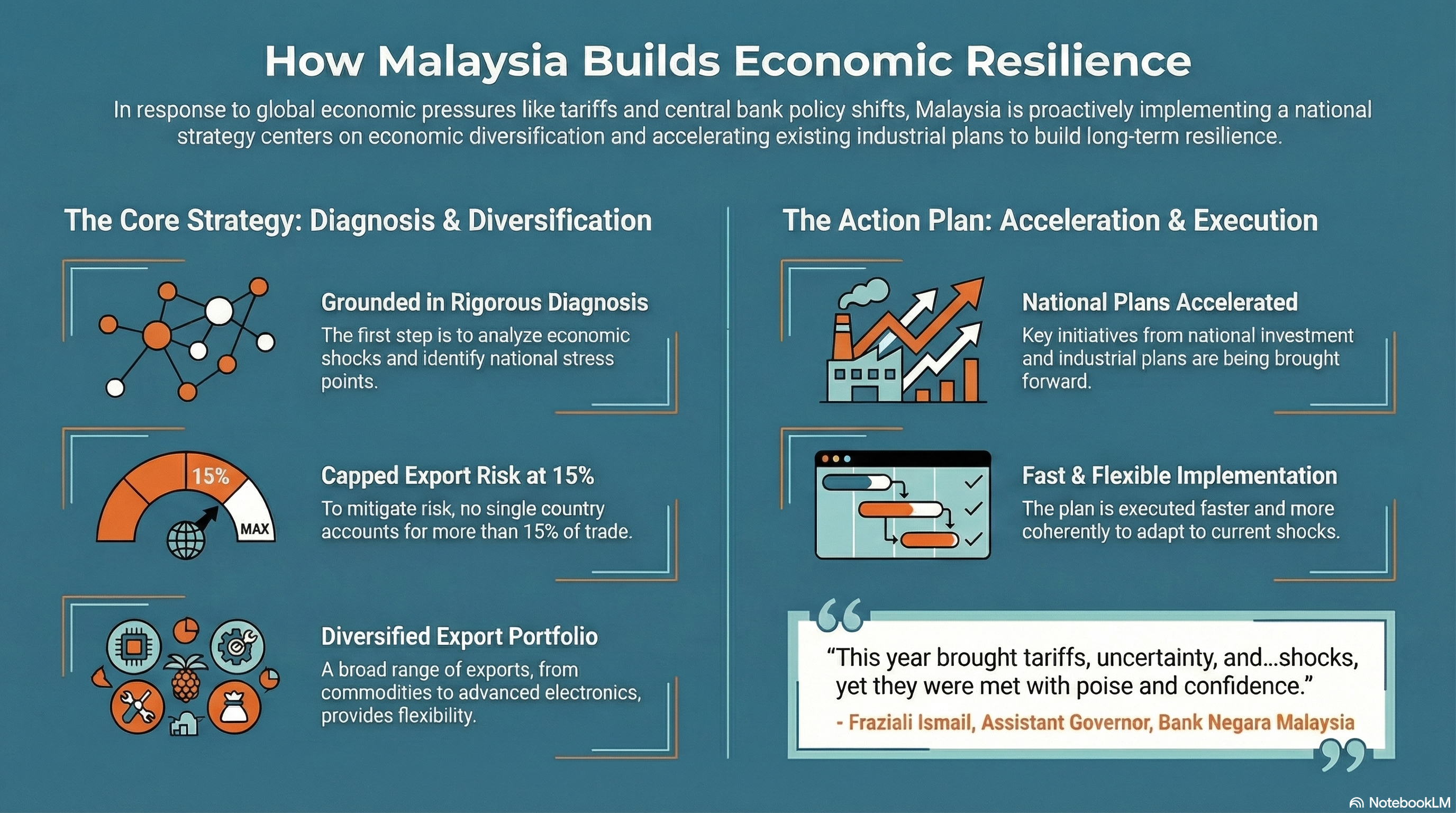
- This year brought tariff, uncertainty, and other central banks’ policy shocks, yet they were met with poise and confidence.
- The response hinges on Malaysia’s intrinsic strength—an economy highly diversified by products and export destinations.
- No single country accounts for more than 15% of trade, and exports range from commodities to advanced electronics, allowing the country to roll with shocks.
- Preparation is anchored in clear diagnosis and in national plans like the National Investment Aspirations and the National Industrial Master Plan that articulate a future vision and execution path.
- External shocks have compelled the team to bring forward, execute faster, and remain flexible so they can navigate current shocks and enter 2026 better prepared.
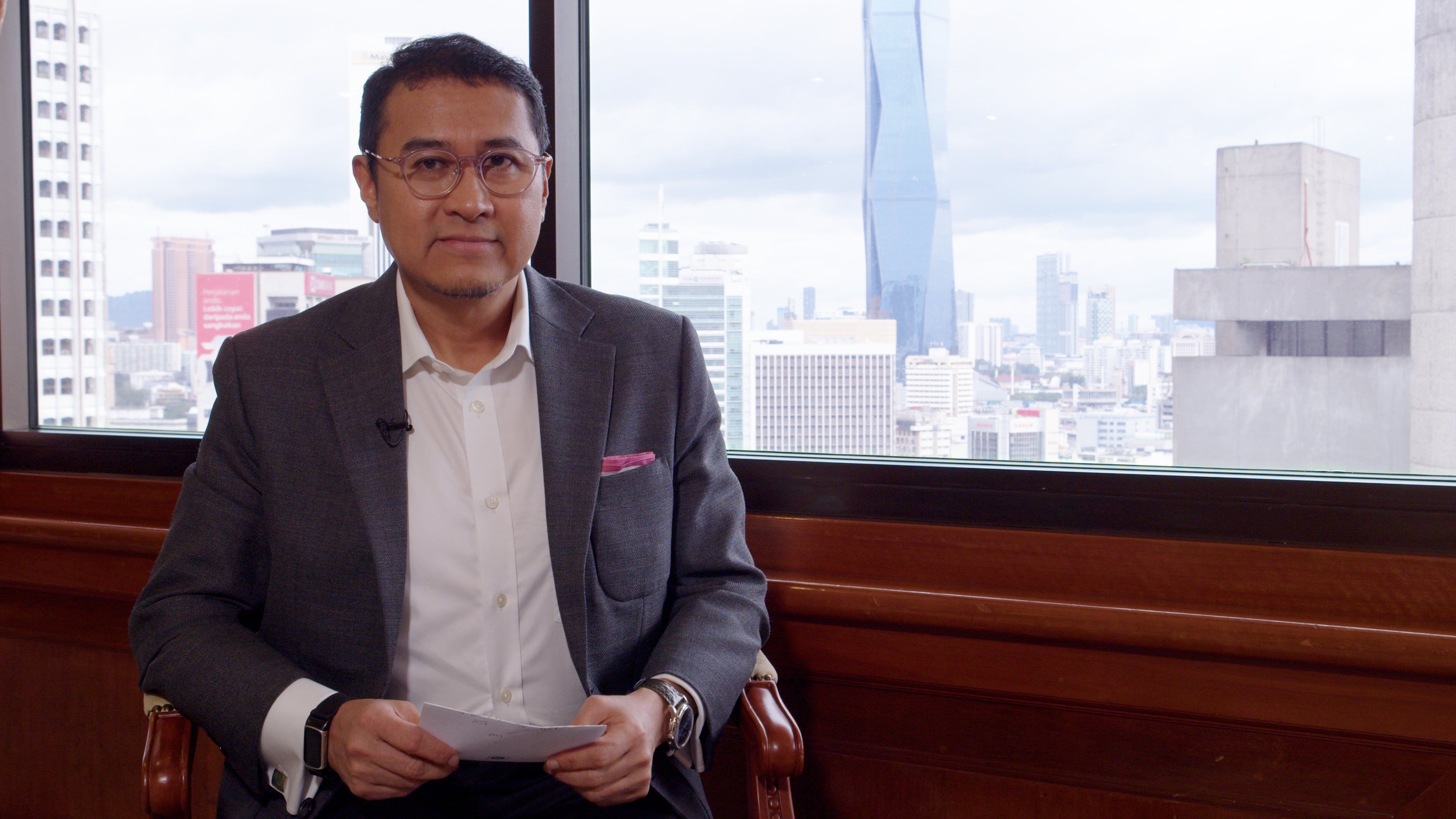
Bank Negara is leaning on Malaysia economic diversification to cushion tariff pressures and policy shifts by other central banks, with officials bringing forward elements of the National Investment Aspirations and the National Industrial Master Plan while accelerating execution ahead of 2026. The strategy centres on clear diagnosis, diversified export destinations where no single country accounts for more than 15 per cent of trade, and product breadth from commodities to advanced electronics. “This year brought tariffs, uncertainty, and other central banks’ policy shocks, yet they were met with poise and confidence,” Fraziali Ismail, Assistant Governor, Bank Negara Malaysia told BackgroundBriefing.news.
Diagnosis and diversification
He said the first priority was a rigorous diagnosis of the shocks and the economy’s stress points, grounding the policy response in Malaysia economic diversification across both markets and products. “Our strengths have always been on how well diversified the economy is. No one country occupies more than 15 per cent of our trade.” On the supply side, the breadth of export offerings—from commodities to advanced electronics—allows the country “to roll with the punches as the shocks come,” Ismail added.
Plans brought forward
BNM also draws on national strategies introduced early in the administration, including the National Investment Aspirations and the National Industrial Master Plan. These are more than paper plans; they are a forward-looking blueprint now being accelerated as external challenges intensify. “What has happened with these external shocks is it compelled us to bring forward a lot of the things that we identified for the future,” the Assistant Governor said. This pull-forward of milestones is positioned as a practical application of Malaysia economic diversification, ensuring capital allocation, industry development and export promotion are sequenced to manage volatility.
Execution and flexibility into 2026
The final pillar is execution: faster, more coherent, and flexible. Officials emphasised that responding to shocks requires adapting timelines and delivery models without losing strategic intent. “The second part of the plan is to execute this in a much coherent way and in a faster way so that we can respond to the current shocks,” Ismail said. Flexibility is presented as both method and outcome—bringing forward planned initiatives, while maintaining room to recalibrate if global tariffs or monetary conditions change. “We handled [the shocks] with our intrinsic strength and going into 2026 we will be seeing more of this; we are prepared as well,” Assistant Governor said. The approach is designed to help Malaysia’s economic diversification translate into real-world resilience, enabling the country to navigate current shocks and move forward into a more stable long-term trajectory.
More stories: Solving cross-border cash control with bank APIs and multi-currency accounts
About the speaker:
Fraziali Ismail
Assistant Governor
Bank Negara Malaysia
Encik Fraziali Ismail, Assistant Governor, Bank Negara Malaysia, oversees financial surveillance, prudential regulation, consumer and market conduct, money services business regulation, and communications. Appointed to bolster supervisory effectiveness, he brings seasoned judgment to safeguarding stability and public trust, steering policy design, industry standards, and stakeholder engagement for resilient, well‑conducted financial markets.
Joining the Bank in 1994, Fraziali served in the economics and monetary policy departments, building expertise in macroeconomic analysis and central banking. He holds a Master’s in Economics from the London School of Economics and Political Science and a Bachelor’s in Economics and Accounting from the University of Bristol.
FAQs:
What were the main challenges faced this year?
Tariffs, heightened uncertainty, and policy actions by other central banks created externally driven shocks that required measured, disciplined responses.
How is Malaysia preparing to navigate into 2026?
The approach relies on intrinsic strengths—especially broad economic diversification—combined with faster, more coherent execution of national plans and flexible implementation to address evolving shocks.
Why is clear diagnosis emphasized as the first step?
A precise diagnosis clarifies the nature of the shocks and stress points, ensuring policies are tailored to the specific challenges rather than generic or reactive measures.
How diversified are Malaysia’s export destinations?
No single country accounts for more than 15% of Malaysia’s trade, which reduces concentration risk and cushions the impact of external disruptions.
What role does product diversification play in resilience?
Malaysia’s export mix spans commodities to advanced electronics, enabling the economy to “roll with the punches” as different sectors absorb shocks at different times.
Which national plans underpin the current strategy?
The National Investment Aspirations and the National Industrial Master Plan provide the vision and roadmap; elements of these plans are being brought forward to respond to present conditions.
How is execution changing to meet external shocks?
Execution is being made more coherent and accelerated, with timelines pulled forward to deliver concrete actions faster while maintaining strategic consistency.
What does flexibility mean in this context?
Flexibility means adjusting sequencing and delivery of planned initiatives to current realities, bringing forward future measures when needed and recalibrating as conditions evolve.
5W1H summary:
| What |
1. Responding to tariffs and policy shocks. 2. Leveraging Malaysia’s diversified export economy. 3. Accelerating national investment and industrial plans. |
| How |
1. Clear diagnosis of challenges and stressors. 2. Faster, coherent execution of national plans. 3. Flexible sequencing to meet external shocks. |
| Why |
1. Diversification reduces single-market dependency. 2. No country exceeds 15% trade exposure. 3. Prepare Malaysia for 2026 volatility. |
| Who |
1. Malaysian administration and economic policymakers. 2. Export sectors from commodities to electronics. 3. Other central banks shaping external conditions. |
| Where |
1. Malaysia across diversified export destinations. 2. ASEAN and broader global trade networks. 3. Impact from foreign central banks’ policies. |
| When |
1. This year’s tariffs and uncertainty shocks. 2. Early administration launched national plans. 3. Accelerated execution ahead of 2026. |
Transcript of the interview:
This year is a year where we had a lot of challenges in terms of tariffs, uncertainty, and policy actions by other central banks. A lot of it are accidentally generated, yet we handled it with poise.
We handled it with our intrinsic strength and going into 2026 we will be seeing more of this. We are prepared as well.
What have you done to prepare?
We have learned that when policy challenges come this way, we should go back to where our strength lies.
- Diagnosis being very clear about what kind of challenges that we are facing is paramount.
We have done the diagnosis and our strengths have always been on how well diversified the economy is. It is a very underrated strength and yet in Malaysia we are highly diversified in terms of products and countries.
By that I mean the destination of our exports. No one country occupies more than 15% of our trade.
When we talk about diversification of products, we have a lot of products for the exports market from commodities to advanced electronics. Here is a country that will be able to roll with the punches as the shocks come.
We are clear on this, hence when we talk about handling the current shocks and preparing for the future, we will be using our strength. We will navigate the current shocks to a better future. - Having a plan and clearly by having a plan we can carry a lot of this much better. You would have recalled in the early days of this administration he came up with a lot of national plans, such as the national investment aspirations and the national industrial master plan.
A lot of these are not just plans, they are a vision for the future on where we want to be and how we want to execute it. What has happened with these external shocks is it compelled us to bring forward a lot of the things that we identified for the future.
The second part of the plan is to execute this in a much coherent way and in a faster way so that we can respond to the current shocks. - For us to be flexible in the way we execute this. Clearly when I talk about having planned for the future and bringing it forward, that exemplifies how we can be flexible. This helps us in terms of dealing with the shocks and moving forward.