

Overview:
- DHL Global Forwarding focuses on freight forwarding, handling large shipments via air, ocean, rail, and road.
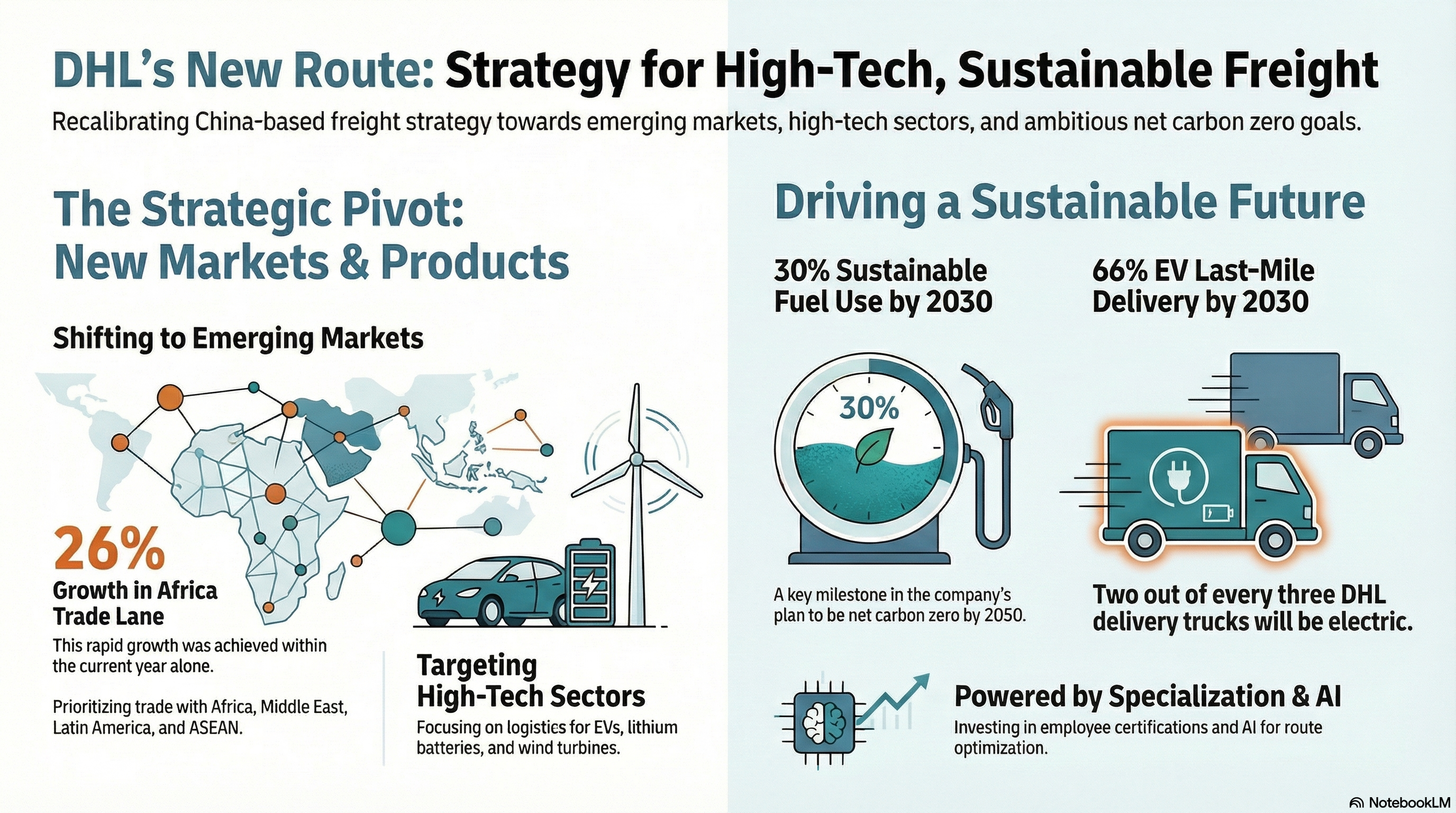
- The company is recalibrating trade lanes from traditional Western markets to emerging regions like Africa, Middle East, Latin America, and ASEAN.
- China’s shift to niche, high-quality production is driving DHL’s pivot toward sectors like EVs, lithium batteries, and wind turbines.
- DHL is investing in sustainable energy and carbon reduction, aiming for 30% sustainable fuel use and 66% EV last-mile delivery by 2030.
- Specialization through certified programs and AI-driven technology is key to DHL’s goal of becoming the market leader in EVs, wind energy, and e-commerce.
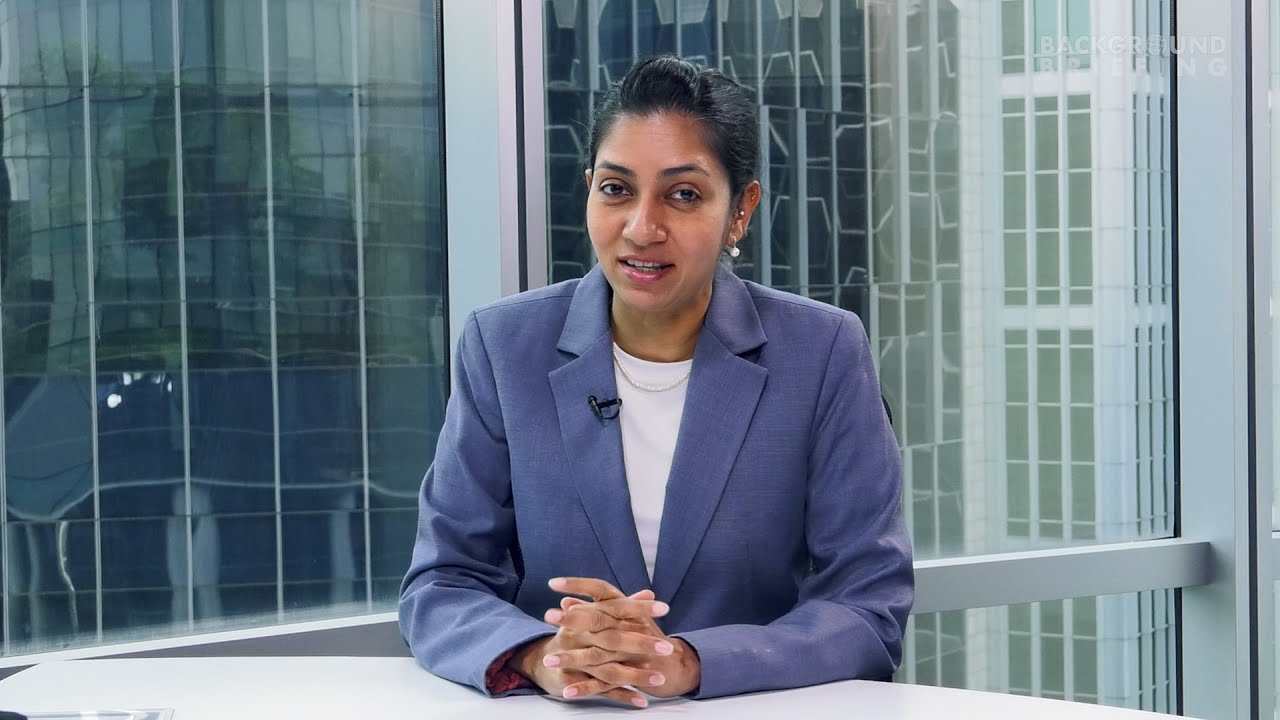
DHL Global Forwarding is recalibrating its freight strategy in China, shifting focus from traditional Western markets to emerging trade lanes and high-tech sectors. Aditi Rasquinha, CEO of Greater China at DHL Global Forwarding, revealed that the company is investing heavily in sustainable energy and specialized logistics to meet evolving global demands.
At a recent group strategy meeting in Singapore, Rasquinha outlined DHL’s pivot toward Africa, the Middle East, Latin America, and ASEAN. “Just this year, the African trade lane has grown over 26% and ASEAN over 15%,” she noted. This shift reflects China’s broader economic transition from mass manufacturing to niche, high-quality production, particularly in electric vehicles (EVs), lithium batteries, and wind turbines.
Sustainability and Specialization Drive DHL’s Freight Strategy
DHL aims to be net carbon zero by 2050, with key milestones set for 2030. These include 30% adoption of sustainable fuels and 66% electrification of last-mile delivery—meaning two out of every three DHL trucks will be electric. The company is also partnering with Chinese EV manufacturers to both export vehicles and integrate them into its own fleet.
“We are ramping up our specialization in people and certifications so that they are equipped to manage the technology that comes about,” added Rasquinha. DHL is investing in certified programs across e-commerce, semiconductors, and industrial logistics, including large-scale projects like wind turbine and oil line transport.
Market Leadership Through Technology and Talent
To achieve its goal of becoming the undisputed market leader in EV logistics, wind energy transport, and e-commerce freight, DHL is combining AI-driven predictive analytics and route optimization with workforce upskilling. The company currently ranks among the top three in these sectors and is pushing to secure the number one spot.
More stories: Global wealth shake-up: Advisers trapped by lag-time as crypto demand soars
About the speaker:
Aditi Rasquinha
CEO of Greater China
DHL Global Forwarding
Aditi Rasquinha is the CEO of Greater China at DHL Global Forwarding, based in Shanghai. She assumed this role in August 2024, bringing over two decades of experience in logistics, procurement, and strategic freight operations across Asia Pacific and Europe. Prior to her current position, she served as Executive Vice President and Head of Oceanfreight for Asia Pacific at DB Schenker, and held senior leadership roles at Kuehne + Nagel and DHL in various countries including the Netherlands, Thailand, Malaysia, and Singapore.
Rasquinha’s career spans strategic account management, product development, and regional leadership, with a strong focus on ocean freight. She is a graduate of Harvard Business School’s General Management Program and Bangalore University. Her leadership is marked by a commitment to innovation, sustainability, and developing certified programs that enhance specialization in logistics and freight forwarding.
FAQs:
What is DHL Global Forwarding’s main business focus?
DHL Global Forwarding specializes in freight forwarding, handling large and bulky shipments via air, ocean, rail, and road.Why is DHL recalibrating its China trade lanes?
DHL is shifting focus from traditional Western markets to emerging regions like Africa, the Middle East, Latin America, and ASEAN due to changing global trade dynamics.How much has the African trade lane grown this year?
The African trade lane has grown by over 26% this year, reflecting DHL’s strategic pivot to new markets.What sectors is DHL targeting in China’s evolving economy?
DHL is focusing on niche, high-quality sectors such as electric vehicles (EVs), lithium batteries, and wind turbines, aligned with China’s new quality productive forces policy.What are DHL’s sustainability goals for 2030?
By 2030, DHL aims to achieve 30% adoption of sustainable fuels and 66% electrification of its last-mile delivery fleet.How is DHL partnering with Chinese EV companies?
DHL collaborates with Chinese EV manufacturers to export vehicles globally and integrate them into its own last-mile delivery operations.What certified programs is DHL investing in?
DHL is developing certified programs in e-commerce, semiconductors, and industrial logistics to enhance specialization and workforce capabilities.How is DHL using technology to improve logistics?
DHL is leveraging AI for predictive analysis and route optimization to enhance clarity and efficiency in freight operations.What is DHL’s market leadership goal?
DHL aims to be the undisputed leader in EV logistics, wind energy transport, and e-commerce freight, ranking number one in these sectors.How is DHL preparing its workforce for future logistics demands?
DHL is ramping up specialization through training and certifications to ensure its people are equipped to manage advanced logistics technologies.5W1H summary:
| What | Details |
|---|---|
| What |
1. Freight forwarding strategy shift 2. Focus on EVs, wind turbines 3. Certified programs in semiconductors |
| How |
1. Recalibrate trade lanes globally 2. Invest in AI, route optimization 3. Upskill teams with certifications |
| Why |
1. Meet shifting global demand 2. Support China’s quality production 3. Achieve sustainability leadership |
| Who |
1. Aditi Rasquinha, CEO 2. DHL Global Forwarding teams 3. Chinese EV partners |
| Where |
1. China, Shanghai hub 2. Africa, Middle East, Latin America 3. ASEAN, Singapore, Malaysia |
| When |
1. Strategy meeting this year 2. 2030 interim sustainability goals 3. Net zero target 2050 |
Transcript of the interview:
DHL global forwarding is only one of the five different business units at DHL group. Most likely we are known for express, which is our B2C or B2B business. I take care of the forwarding division, which is freight forwarding. It is the large bulky shipments that move on air, ocean, rail, or road.
Because you do not visit Singapore all that often because you are mostly ensconced in China. What is the thing that you are here to work on at the moment?
I am here for our group strategy meeting. It is a pivot point to check where we are at for this year and what we are doing for next year, and my focus is on recalibration, pivoting, as well as investment. If we talk a little bit about recalibrating, the China trade lanes have changed from traditional markets, western markets, to focus on new trade lanes like Africa, Middle East, Latin America, and ASEAN.
Just this year, the African trade lane has grown over 26% and ASEAN over 15%. If we look at pivoting, China’s traditional sectors like tech or large-scale manufacturing are now moving into more niche, high-quality production.
If you look at China government policy on new quality productive forces, this really focuses on the development of wind turbines, lithium batteries, as well as EV manufacturing. If we just look at the first half of this year, EV cars and batteries have grown more than 20% year-on-year.
Our investment is into areas of new energy and carbon. We want to be net carbon zero by 2050. In order to achieve that by 2030, we have a few milestones. We want to get to about 30% absorption of sustainable fuels and 66% of electrification of our last mile. That means every two out of three yellow trucks you see on the road will be EV.
What is DHL doing in the space that is different from other operators in China?
As DHL we are partnering with Chinese EV companies. We look at how we can send their cars overseas but also how we can buy their vehicles and absorb and use them in our last mile.
What is DHL bringing to these China investments?
We are looking at certified programs. We are looking at certified programs into e-commerce semiconductor as well as industrial projects. This looks at the really large projects of moving wind turbines or oil lines across the scheme.
We are ramping up our people in terms of their knowledge as well as skill sets. We take this in a combination of people as well as technology. How do we invest in our technology to create that clarity using AI, bringing in predictive analysis, as well as route optimization?
We are ramping up our specialization in people and certifications so that they are equipped to manage the technology that comes about.
And what are the outcomes or the KPIs that you are aiming for?
We are aiming for being market leader. Of course, having the largest market share in the EV spectrum, in the wind turbine spectrum, as well as e-commerce.
We always rank between 1 and 3, and we want to be the undisputed leader at number one. In order to do that we have to be a specialist on these aspects. In order to be the specialist, we have focused on these certified programs.